
Ch. 27 - Magnetism
Giancoli Douglas - Physics for Scientists and Engineers 5th edition
Giancoli Douglas5th editionPhysics for Scientists and EngineersISBN: 9780137488179Not the one you use?Change textbook
Chapter 26, Problem 15

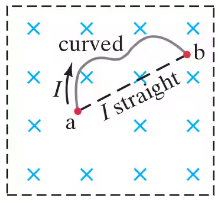
(III) A curved wire, connecting two points a and b, lies in a plane perpendicular to a uniform magnetic field B\(\overrightarrow{B}\) and carries a current I. Show that the resultant magnetic force on the wire, no matter what its shape, is the same as that on a straight wire connecting the two points carrying the same current I. See Fig. 27–44.

Verified step by step guidance
1
The magnetic force on a current-carrying wire in a magnetic field is given by the formula: **F = I ∫ (dl × B)**, where **dl** is the infinitesimal vector element of the wire, **B** is the magnetic field vector, and **×** represents the cross product.
The key observation here is that the magnetic field **B** is uniform and constant in magnitude and direction. This allows us to treat **B** as a constant vector throughout the integration process.
The integral **∫ (dl × B)** can be rewritten as **B × ∫ dl**, because the cross product with a constant vector can be factored out of the integral. This simplifies the problem to evaluating the integral of **dl**, which represents the vector sum of all infinitesimal elements of the wire.
The vector sum **∫ dl** is simply the displacement vector from point **a** to point **b**, regardless of the shape of the wire. This is because the integral of **dl** over a path gives the net displacement between the start and end points.
Thus, the magnetic force becomes **F = I (B × d)**, where **d** is the straight-line displacement vector from **a** to **b**. This shows that the resultant magnetic force depends only on the endpoints of the wire and not on its shape, proving that the force on the curved wire is the same as that on a straight wire connecting the two points.

Verified video answer for a similar problem:

This video solution was recommended by our tutors as helpful for the problem above.
Video duration:
3m
Was this helpful?

Key Concepts

Here are the essential concepts you must grasp in order to answer the question correctly.

Magnetic Force on a Current-Carrying Wire

The magnetic force experienced by a current-carrying wire in a magnetic field is given by the equation F = I(L × B), where F is the force, I is the current, L is the length vector of the wire, and B is the magnetic field vector. This force is perpendicular to both the direction of the current and the magnetic field, resulting in a force that can vary depending on the wire's orientation and shape.

Biot-Savart Law

The Biot-Savart Law describes the magnetic field generated by a current-carrying conductor. It states that the magnetic field dB at a point in space due to a small segment of current-carrying wire is proportional to the current and the length of the segment, and inversely proportional to the square of the distance from the segment to the point. This law helps in understanding how the shape of the wire affects the resultant magnetic field and force.

Superposition Principle

The superposition principle in physics states that the total force acting on an object is the vector sum of all individual forces acting on it. In the context of a curved wire in a magnetic field, this principle allows us to analyze the magnetic forces on infinitesimal segments of the wire and sum them up to find the total force, demonstrating that the resultant force on a curved wire can be equivalent to that on a straight wire connecting the same endpoints.
Related Practice
Textbook Question

(II) A current-carrying circular loop of wire (radius r, current I) is partially immersed in a magnetic field of constant magnitude B₀ directed out of the page as shown in Fig. 27–43. Determine the net force on the loop due to the field in terms of θ₀. (Note that θ₀ points to the dashed line, above which B = 0.)

1798
views
Textbook Question

A stiff wire 50.0 cm long is bent at a right angle in the middle. One section lies along the z axis and the other is along the line y = 2x in the xy plane. A current of 20.0 A flows in the wire—down the z axis and out the wire in the xy plane. The wire passes through a uniform magnetic field given by = (0.285î ) T. Determine the magnitude and direction of the total force on the wire.

1396
views
Textbook Question

For a particle of mass m and charge q moving in a circular path in a magnetic field B, (a) show that its kinetic energy is proportional to r², the square of the radius of curvature of its path. Show that its angular momentum is L=qBr² , around the center of the circle.

1414
views
Textbook Question

The magnetic force per meter on a wire is measured to be only 55% of its maximum possible value. What is the angle between the wire and the magnetic field?

1409
views
Textbook Question

A particle of charge q moves in a circular path of radius r in a uniform magnetic field B\(\overrightarrow{B}\). If the magnitude of the magnetic field is doubled, and the kinetic energy of the particle remains constant, what happens to the angular momentum of the particle?

1838
views
Textbook Question

A 720-KeV (kinetic energy) proton enters a 0.20-T field, in a plane perpendicular to the field. What is the radius of its path? See Section 23–8.

1505
views