Ch. 11 - Angular Momentum; General Rotation
Giancoli Douglas - Physics for Scientists and Engineers 5th edition
Giancoli Douglas5th editionPhysics for Scientists and EngineersISBN: 9780137488179Not the one you use?Change textbook
Chapter 11, Problem 49b

Two ice skaters, both of mass 68 kg, approach on parallel paths 1.6 m apart. Both are moving at 3.5 m/s with their arms outstretched. They join hands as they pass, still maintaining their 1.6-m separation, and begin rotating about one another. Treat the skaters as particles with regard to their rotational inertia. Calculate the change in kinetic energy for this process.

Verified step by step guidance
1
First, identify the initial kinetic energy of the system. Since both skaters are moving in straight lines at the same speed, their initial kinetic energy is purely translational. The formula for the translational kinetic energy of each skater is \( KE_{\text{initial}} = \frac{1}{2} m v^2 \), where \( m \) is the mass of one skater and \( v \) is their velocity. Multiply this by 2 to account for both skaters.
Next, consider the final state of the system. After the skaters join hands, they begin rotating about their center of mass. The system now has rotational kinetic energy. The formula for rotational kinetic energy is \( KE_{\text{rotational}} = \frac{1}{2} I \omega^2 \), where \( I \) is the moment of inertia of the system and \( \omega \) is the angular velocity.
Calculate the moment of inertia \( I \) for the system. Treat the skaters as point masses located at a distance \( r = 0.8 \ \text{m} \) (half the separation distance) from the center of mass. The moment of inertia for each skater is \( I = m r^2 \), and the total moment of inertia is \( I_{\text{total}} = 2 m r^2 \).
Determine the angular velocity \( \omega \) of the system. Use the principle of conservation of angular momentum, which states that the initial angular momentum equals the final angular momentum. The initial angular momentum is \( L_{\text{initial}} = 2 m v r \), and the final angular momentum is \( L_{\text{final}} = I_{\text{total}} \omega \). Solve for \( \omega \) using \( \omega = \frac{L_{\text{initial}}}{I_{\text{total}}} \).
Finally, calculate the change in kinetic energy. Subtract the final rotational kinetic energy from the initial translational kinetic energy: \( \Delta KE = KE_{\text{final}} - KE_{\text{initial}} \). Use the values obtained for \( KE_{\text{initial}} \), \( I_{\text{total}} \), and \( \omega \) to compute \( KE_{\text{final}} \).

Verified video answer for a similar problem:

This video solution was recommended by our tutors as helpful for the problem above.
Video duration:
12m
Was this helpful?

Key Concepts

Here are the essential concepts you must grasp in order to answer the question correctly.

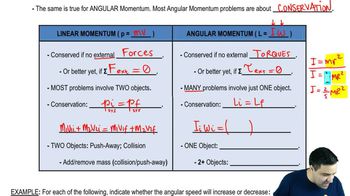
Conservation of Angular Momentum

In a closed system with no external torques, the total angular momentum remains constant. When the two skaters join hands and start rotating, their combined angular momentum before they join must equal their angular momentum after they start rotating. This principle is crucial for analyzing the motion and determining the final state of the system.
Recommended video:
Guided course
12:12
Conservation of Angular Momentum

Rotational Kinetic Energy

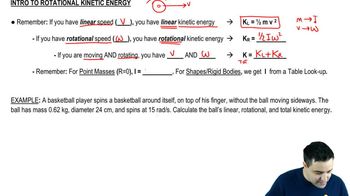
Rotational kinetic energy is the energy possessed by an object due to its rotation, calculated using the formula KE_rot = 1/2 I ω², where I is the moment of inertia and ω is the angular velocity. Understanding how to calculate the moment of inertia for the skaters and how it changes when they start rotating together is essential for determining the change in kinetic energy.
Recommended video:
Guided course
06:07
Intro to Rotational Kinetic Energy

Kinetic Energy Change

The change in kinetic energy during a process is the difference between the initial and final kinetic energies of the system. In this scenario, it involves calculating the initial kinetic energy of the skaters before they join hands and the final kinetic energy after they start rotating together, allowing us to quantify the energy transformation that occurs during the interaction.
Recommended video:
Guided course
06:07
Intro to Rotational Kinetic Energy
Related Practice
Textbook Question

Two identical particles have equal but opposite momenta, p\(\overrightarrow{p}\) and p-\(\overrightarrow{p}\), but they are not traveling along the same line. Show that the total angular momentum of this system does not depend on the choice of origin.

1407
views

Textbook Question

Two ice skaters, both of mass 68 kg, approach on parallel paths 1.6 m apart. Both are moving at 3.5 m/s with their arms outstretched. They join hands as they pass, still maintaining their 1.6-m separation, and begin rotating about one another. Treat the skaters as particles with regard to their rotational inertia. If they now pull on each other’s hands, reducing their radius to half its original value, what is their common angular speed after reducing their radius?

915
views
Textbook Question

Suppose a 5.2 x 10¹⁰kg meteorite struck the Earth at the equator with a speed v = 2.2 x 10⁴ m/s, as shown in Fig. 11–38 and remained stuck. By what factor would this affect the rotational frequency of the Earth (1 rev/day)?

<IMAGE>

1607
views
Textbook Question

A particle is at the position (x, y, z) = (1.0, 2.0, 3.0)m. It is traveling with a vector velocity (-5.0 ,+ 2.8, -3.1)m/s. Its mass is 4.3 kg. What is its vector angular momentum about the origin?

1540
views
Textbook Question

Two lightweight rods 24 cm in length are mounted perpendicular to an axle and at 180° to each other (Fig. 11–35). At the end of each rod is a 480-g mass. The rods are spaced 42 cm apart along the axle. The axle rotates at 4.5 rad/s.

(a) What is the component of the total angular momentum along the axle?

(b) What angle does the vector angular momentum make with the axle? [Hint: Remember that the vector angular momentum must be calculated about the same point for both masses, which could be the cm.]

1526
views
Textbook Question

Two ice skaters, both of mass 68 kg, approach on parallel paths 1.6 m apart. Both are moving at 3.5 m/s with their arms outstretched. They join hands as they pass, still maintaining their 1.6-m separation, and begin rotating about one another. Treat the skaters as particles with regard to their rotational inertia. They now pull on each other’s hands, reducing their radius to half its original value. Calculate the change in kinetic energy for this process.

1341
views