
Ch. 24 - Capacitance, Dielectrics, Electric Energy, Storage
Giancoli Douglas - Physics for Scientists and Engineers 5th edition
Giancoli Douglas5th editionPhysics for Scientists and EngineersISBN: 9780137488179Not the one you use?Change textbook
Chapter 23, Problem 95

Capacitors can be used as “electric charge counters.” Consider an initially uncharged capacitor of capacitance C with its bottom plate grounded and its top plate connected to a source of electrons. If N electrons flow onto the capacitor’s top plate, show that the resulting potential difference V across the capacitor is directly proportional to N.

Verified step by step guidance
1
Start by recalling the relationship between charge (Q), capacitance (C), and potential difference (V) for a capacitor: Q = C \(\cdot\) V. This equation tells us that the charge stored on a capacitor is proportional to the product of its capacitance and the potential difference across it.
Next, recognize that the charge (Q) on the capacitor is related to the number of electrons (N) that flow onto the top plate. Since each electron has a charge of e = 1.6 \(\times\) 10^{-19} \ \(\text{C}\), the total charge is given by Q = N \(\cdot\) e.
Substitute the expression for Q from the second step into the capacitor equation Q = C \(\cdot\) V. This gives: N \(\cdot\) e = C \(\cdot\) V.
Rearrange the equation to solve for the potential difference (V): V = \(\frac{N \cdot e}{C}\). This shows that the potential difference is proportional to the number of electrons (N), with the proportionality constant being \(\frac{e}{C}\).
Conclude that the potential difference (V) across the capacitor is directly proportional to the number of electrons (N) that flow onto its top plate, as derived in the equation V = \(\frac{N \cdot e}{C}\).

Verified video answer for a similar problem:

This video solution was recommended by our tutors as helpful for the problem above.
Video duration:
2m
Was this helpful?

Key Concepts

Here are the essential concepts you must grasp in order to answer the question correctly.

Capacitance

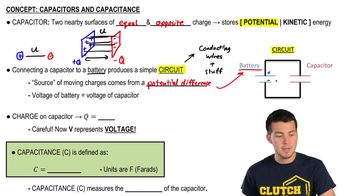
Capacitance is a measure of a capacitor's ability to store electric charge per unit voltage. It is defined as the ratio of the charge (Q) stored on one plate of the capacitor to the potential difference (V) across the plates, expressed as C = Q/V. In this context, a capacitor with capacitance C will store charge when electrons are added, affecting the voltage across its plates.
Recommended video:
Guided course
08:02
Capacitors & Capacitance (Intro)

Electric Charge

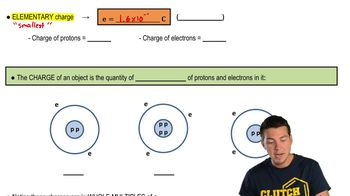
Electric charge is a fundamental property of matter that causes it to experience a force when placed in an electromagnetic field. In this scenario, electrons, which carry a negative charge, flow onto the capacitor's top plate. The total charge (Q) on the capacitor increases with the number of electrons (N) added, leading to a change in the potential difference across the capacitor.
Recommended video:
Guided course
05:37
Electric Charge

Potential Difference

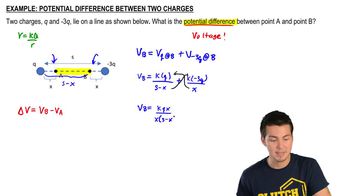
Potential difference, or voltage (V), is the work done per unit charge to move a charge between two points in an electric field. For a capacitor, the potential difference is directly related to the amount of charge stored. As more electrons flow onto the capacitor's top plate, the potential difference increases proportionally, illustrating the relationship V = Q/C, where Q is the total charge and C is the capacitance.
Recommended video:
Guided course
07:04
Potential Difference Between Two Charges