
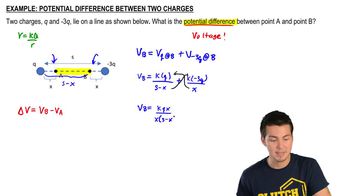
In lightning storms, the potential difference between the Earth and the bottom of the thunderclouds can be as high as 35,000,000 V. The bottoms of thunderclouds are typically 1500 m above the Earth, and can have an area of 110 km². Modeling the Earth–cloud system as a huge capacitor, calculate the capacitance of the Earth–cloud system,
Giancoli Douglas 5th edition
Ch. 24 - Capacitance, Dielectrics, Electric Energy, Storage
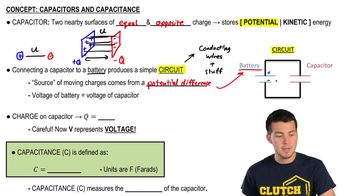
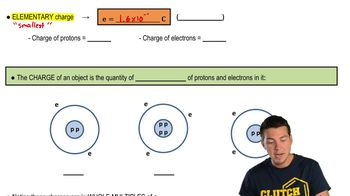
Problem 95Capacitors can be used as “electric charge counters.” Consider an initially uncharged capacitor of capacitance C with its bottom plate grounded and its top plate connected to a source of electrons. If N electrons flow onto the capacitor’s top plate, show that the resulting potential difference V across the capacitor is directly proportional to N.
Verified step by step guidance
Verified video answer for a similar problem:
Key Concepts
Capacitance
Electric Charge
Potential Difference
A parallel-plate capacitor with plate area 2.0 cm² and air-gap separation 0.50 mm is connected to a 12-V battery, and fully charged. The battery is then disconnected. What is the charge on the capacitor?
A parallel-plate capacitor has square plates 12 cm on a side separated by 0.10 mm of plastic with a dielectric constant of K = 3.8. The plates are connected to a battery, causing them to become oppositely charged. Since the oppositely charged plates attract each other, they exert a pressure on the dielectric. If this pressure is 40.0 Pa, what is the battery voltage?
A parallel-plate capacitor with plate area 2.0 cm² and air-gap separation 0.50 mm is connected to a 12-V battery, and fully charged. The battery is then disconnected. The plates are now pulled to a separation of 0.85 mm. What is the charge on the capacitor now?