
Ch. 31 - Maxwell's Equations and Electromagnetic Waves
Giancoli Douglas - Physics for Scientists and Engineers 5th edition
Giancoli Douglas5th editionPhysics for Scientists and EngineersISBN: 9780137488179Not the one you use?Change textbook
Chapter 30, Problem 7a

Suppose that a circular parallel-plate capacitor has radius r₀ = 3.0 cm and plate separation d = 5.0 mm. A sinusoidal potential difference V = V₀ sin (2𝝅ft) is applied across the plates, where V₀ = 180 V and f = 60 Hz. In the region between the plates, show that the magnitude of the induced magnetic field is given by B = B₀(r) cos (2𝝅ft), where B₀(r) is a function of the radial distance r from the capacitor’s central axis.

Verified step by step guidance
1
Start by recalling that a time-varying electric field between the plates of a capacitor induces a magnetic field according to Maxwell's equations. Specifically, the displacement current density, which arises from the changing electric field, acts as a source for the magnetic field.
The displacement current density, J_d, is given by: Jd=εddtE, where ε is the permittivity of free space and E is the electric field between the plates. The electric field is related to the potential difference by E=Vd, where d is the plate separation.
Substitute the sinusoidal potential difference V=Vsin(2πft) into the expression for E. This gives E=Vsin(2πft)d. Differentiate E with respect to time to find ddtE.
Using Ampere-Maxwell's law in its integral form, relate the induced magnetic field to the displacement current. The law states: CB·dl=μId, where Id is the displacement current enclosed by the loop. For a circular loop of radius r, the magnetic field is uniform along the loop, so B=μεrddtE.
Finally, substitute the expression for ddtE into the equation for B. Simplify to show that the magnetic field has the form B=B(r)cos(2πft), where B(r) is a function of the radial distance r.

Verified video answer for a similar problem:

This video solution was recommended by our tutors as helpful for the problem above.
Video duration:
11m
Was this helpful?

Key Concepts

Here are the essential concepts you must grasp in order to answer the question correctly.

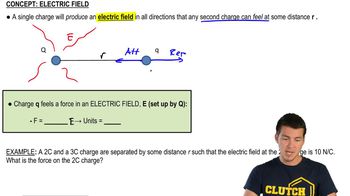
Capacitance and Electric Fields

A capacitor stores electrical energy in an electric field created between its plates. The capacitance, defined as the ability to store charge per unit voltage, is influenced by the plate area and separation. In this scenario, the sinusoidal voltage creates a time-varying electric field between the plates, which is essential for understanding how the electric field influences the surrounding space.
Recommended video:
Guided course
03:16
Intro to Electric Fields

Maxwell's Equations

Maxwell's Equations describe how electric and magnetic fields interact and propagate. Specifically, Faraday's law of induction states that a changing electric field induces a magnetic field. This principle is crucial for deriving the relationship between the time-varying electric field in the capacitor and the resulting magnetic field in the surrounding region.
Recommended video:
Guided course
08:25
Kinematics Equations

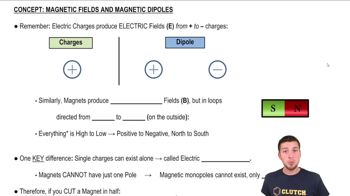
Induced Magnetic Field

The induced magnetic field arises from the changing electric field between the capacitor plates. According to electromagnetic theory, the magnitude and direction of this magnetic field depend on the rate of change of the electric field and the distance from the source. In this case, the magnetic field's dependence on the radial distance r from the capacitor's axis is key to understanding the behavior of the field in the specified configuration.
Recommended video:
Guided course
05:30
Magnetic Fields and Magnetic Dipoles
Related Practice
Textbook Question

Suppose that a circular parallel-plate capacitor has radius r₀ = 3.0 cm and plate separation d = 5.0 mm. A sinusoidal potential difference V = V₀ sin (2𝝅ft) is applied across the plates, where V₀ = 180 V and f = 60 Hz. Determine the expression for the amplitude B₀(r) of this time-dependent (sinusoidal) field when r ≤ r₀ and when r > r₀.

1061
views
Textbook Question

In an EM wave traveling west, the B field oscillates up and down vertically and has a frequency of 85.0 kHz and an rms strength of 7.75 x 10⁻⁹ T. Determine the frequency and rms strength of the electric field. What is the direction of the electric field oscillations?

3
views
Textbook Question

Suppose an air-gap capacitor has circular plates of radius r = 2.5 cm and separation d = 1.6 mm. A 68.0-Hz emf, ε = ε₀ cos ωt, is applied to the capacitor. The maximum displacement current is 35 μA. Determine the maximum conduction current I. Neglect fringing.

1400
views
Textbook Question

Suppose an air-gap capacitor has circular plates of radius r = 2.5 cm and separation d = 1.6 mm. A 68.0-Hz emf, ε = ε₀ cos ωt, is applied to the capacitor. The maximum displacement current is 35 μA. Determine the maximum value of dΦE/dt between the plates. Neglect fringing.

1283
views
Textbook Question

(a) When a circular parallel-plate capacitor is being charged as in Example 31–1, show that the Poynting vector S\(\overrightarrow{S}\) points radially inward toward the center of the capacitor, parallel to the plates.

(b) Integrate S\(\overrightarrow{S}\) over the cylindrical boundary of the capacitor gap to show that the rate at which energy enters the capacitor is equal to the rate at which electrostatic energy is being stored in the electric field of the capacitor (Section 24–4). Ignore fringing of E\(\overrightarrow{E}\).

6
views
Textbook Question

Suppose an air-gap capacitor has circular plates of radius r = 2.5 cm and separation d = 1.6 mm. A 68.0-Hz emf, ε = ε₀ cos ωt, is applied to the capacitor. The maximum displacement current is 35 μA. Determine the value of ε₀. Neglect fringing.

1066
views