Ch. 15 - Wave Motion
Giancoli Douglas - Physics for Scientists and Engineers 5th edition
Giancoli Douglas5th editionPhysics for Scientists and EngineersISBN: 9780137488179Not the one you use?Change textbook
Chapter 15, Problem 7

A 0.40-kg cord is stretched between two supports 8.7 m apart. When one support is struck by a hammer, a transverse wave travels down the cord and reaches the other support in 0.85 s. What is the tension in the cord?

Verified step by step guidance
1
Determine the speed of the transverse wave using the formula for wave speed: v = dt, where d is the distance the wave travels (8.7 m) and t is the time it takes (0.85 s).
Use the relationship between wave speed, tension, and linear mass density: v = Tμ, where v is the wave speed, T is the tension in the cord, and μ is the linear mass density.
Calculate the linear mass density μ using the formula: μ = mL, where m is the mass of the cord (0.40 kg) and L is its length (8.7 m).
Rearrange the wave speed formula to solve for tension: T = μv^2. Substitute the values of μ and v into this equation.
Simplify the expression to find the tension T in the cord. Ensure all units are consistent (e.g., meters, kilograms, seconds) throughout the calculation.

Verified video answer for a similar problem:

This video solution was recommended by our tutors as helpful for the problem above.
Video duration:
4m
Was this helpful?

Key Concepts

Here are the essential concepts you must grasp in order to answer the question correctly.

Wave Speed

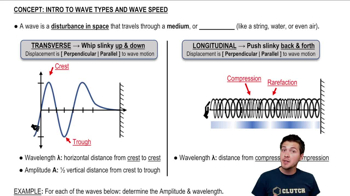
Wave speed is the distance a wave travels per unit of time. It can be calculated using the formula v = d/t, where v is the wave speed, d is the distance traveled, and t is the time taken. In this scenario, the wave travels 8.7 m in 0.85 s, allowing us to determine the speed of the wave in the cord.
Recommended video:
Guided course
07:19
Intro to Waves and Wave Speed

Tension in a Cord

Tension is the force exerted along the length of a cord or string when it is pulled tight. The tension in a cord affects the speed of a wave traveling through it, as described by the formula v = √(T/μ), where T is the tension and μ is the linear mass density of the cord. Understanding how tension influences wave speed is crucial for solving the problem.
Recommended video:
Guided course
06:34
Calculating Tension in a Pendulum with Energy Conservation

Linear Mass Density

Linear mass density (μ) is defined as the mass per unit length of a cord, calculated as μ = m/L, where m is the mass and L is the length. In this case, the cord has a mass of 0.40 kg and a length of 8.7 m. Knowing the linear mass density is essential for calculating the tension in the cord using the wave speed.
Recommended video:
Guided course
04:33
Problems with Mass, Volume, & Density