

Ch. 14 - Oscillations
Giancoli Douglas - Physics for Scientists and Engineers 5th edition
Giancoli Douglas5th editionPhysics for Scientists and EngineersISBN: 9780137488179Not the one you use?Change textbook
Chapter 14, Problem 99

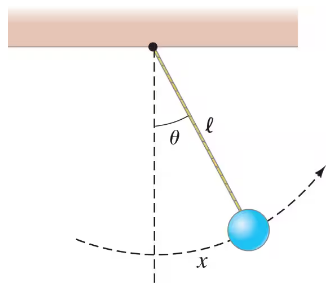
In Section 14–5, the oscillation of a simple pendulum (Fig. 14–48) is viewed as linear motion along the arc length 𝓍 and analyzed via F = ma. Alternatively, the pendulum’s movement can be regarded as rotational motion about its point of support and analyzed using T = Iα. Carry out this alternative analysis and show that θ (t) = θₘₐₓ cos (gl\(\sqrt{\frac{g}{l}\)}t + θ), where θ (t) is the angular displacement of the pendulum from the vertical at time t, as long as its maximum value is less than about .

Verified step by step guidance
1
Start by recognizing that the pendulum's motion can be analyzed as rotational motion about its pivot point. The torque (T) acting on the pendulum is due to the gravitational force, and it is given by T = -m g ℓ sin(θ), where m is the mass of the pendulum bob, g is the acceleration due to gravity, ℓ is the length of the pendulum, and θ is the angular displacement.
Apply Newton's second law for rotational motion: T = Iα, where I is the moment of inertia of the pendulum about the pivot point, and α is the angular acceleration. For a simple pendulum, I = mℓ². Substituting the expressions for T and I, we get -m g ℓ sin(θ) = mℓ² α.
Simplify the equation by canceling mℓ on both sides (assuming m ≠ 0 and ℓ ≠ 0): -g sin(θ) = ℓ α. Recall that angular acceleration α is the second derivative of angular displacement θ with respect to time, so α = d²θ/dt². Substituting this, we get d²θ/dt² = -(g/ℓ) sin(θ).
For small angular displacements (θ ≪ 1 radian), we can use the small-angle approximation sin(θ) ≈ θ. This simplifies the equation to d²θ/dt² = -(g/ℓ) θ. This is a second-order linear differential equation of the form d²θ/dt² + (g/ℓ) θ = 0, which describes simple harmonic motion.
The general solution to this differential equation is θ(t) = θₘₐₓ cos(√(g/ℓ) t + φ), where θₘₐₓ is the maximum angular displacement, and φ is the phase constant determined by initial conditions. This matches the desired result, showing that the pendulum undergoes simple harmonic motion for small angular displacements.

Verified video answer for a similar problem:

This video solution was recommended by our tutors as helpful for the problem above.
Video duration:
7m
Was this helpful?

Key Concepts

Here are the essential concepts you must grasp in order to answer the question correctly.

Simple Harmonic Motion (SHM)

Simple Harmonic Motion is a type of periodic motion where an object oscillates around an equilibrium position. In the context of a pendulum, SHM occurs when the restoring force is directly proportional to the displacement from the equilibrium position, leading to sinusoidal motion. The angular displacement of the pendulum can be described using trigonometric functions, such as cosine, which reflects the periodic nature of the motion.
Recommended video:
Guided course
07:52
Simple Harmonic Motion of Pendulums

Rotational Dynamics

Rotational dynamics involves the study of the motion of objects that rotate about an axis. The key equation T = Iα relates torque (T) to the moment of inertia (I) and angular acceleration (α). For a pendulum, analyzing its motion in terms of rotational dynamics allows us to derive equations of motion that describe how the angle changes over time, particularly when considering forces acting at a distance from the pivot point.
Recommended video:
Guided course
08:12
Torque & Acceleration (Rotational Dynamics)

Pendulum Motion and Angular Displacement

The motion of a pendulum can be described in terms of angular displacement, which is the angle θ that the pendulum makes with the vertical. The equation θ(t) = θₘₐₓ cos(√(g/ℓ) t + φ) captures how this angle varies with time, where θₘₐₓ is the maximum angular displacement, g is the acceleration due to gravity, and ℓ is the length of the pendulum. This relationship illustrates the oscillatory nature of the pendulum's motion and its dependence on physical parameters.
Recommended video:
Guided course
07:52
Simple Harmonic Motion of Pendulums