Ch. 36 - The Special Theory of Relativity
Giancoli Douglas - Physics for Scientists and Engineers 5th edition
Giancoli Douglas5th editionPhysics for Scientists and EngineersISBN: 9780137488179Not the one you use?Change textbook
Chapter 35, Problem 60

(III) (a) In reference frame S, a particle has momentum p=pxi\(\overrightarrow{\mathbf{p}\)}=p_{x}\(\mathbf{i}\) along the positive x axis. Show that in frame S’, which moves with speed v as in Fig. 36–12, the momentum has components
px=pxvE/c21v2/c2p_{x}^{\(\prime\)}=\(\frac{px-vE/c^2}{\sqrt{1-v^2/c^2}\)}
py=pyp_{y}^{\(\prime\)}=py
pz=pzp_{z}^{\(\prime\)}=pz
E=Epxv1v2/c2.E^{\(\prime\)}=\(\frac{E-p_{x}\)v}{\(\sqrt{1-v^2/c^2}\)}.
(These transformation equations hold, actually, for any direction of p\(\overrightarrow{\mathbf{p}\)}, as long as the motion of S' is along the x axis.) (b) Show that px, py, pz, E/c transform according to the Lorentz transformation in the same way as x, y, z, ct.

Verified step by step guidance
1
Step 1: Begin by understanding the problem. The goal is to derive the transformation equations for the momentum components and energy of a particle as observed in two reference frames, S and S'. Frame S' is moving with velocity v relative to frame S along the x-axis. This involves using relativistic principles, specifically the Lorentz transformation.
Step 2: Recall the relativistic energy-momentum relationship. The total energy E and momentum components pₓ, pᵧ, p_𝓏 are related by the equation: E² = (pc)² + (m₀c²)², where p is the magnitude of the momentum vector, m₀ is the rest mass, and c is the speed of light. This relationship will be useful in understanding how energy and momentum transform between frames.
Step 3: Apply the Lorentz transformation for the x-axis motion. The Lorentz transformation equations for time and space are: x' = (x - vt) / √(1 - v²/c²) and t' = (t - vx/c²) / √(1 - v²/c²). Similarly, for energy and momentum, the transformations are: p'ₓ = (pₓ - vE/c²) / √(1 - v²/c²), E' = (E - pₓv) / √(1 - v²/c²). These equations describe how the x-component of momentum and energy transform between the two frames.
Step 4: For the perpendicular components of momentum (pᵧ and p_𝓏), note that they remain unchanged because the relative motion between the frames is along the x-axis. Thus, p'ᵧ = pᵧ and p'_𝓏 = p_𝓏. This is consistent with the fact that the Lorentz transformation does not affect components perpendicular to the direction of relative motion.
Step 5: To show that pₓ, pᵧ, p_𝓏, and E/c transform in the same way as x, y, z, and ct, compare the transformation equations for momentum and energy with those for space and time. The structure of the equations is identical, demonstrating that the four-momentum (E/c, pₓ, pᵧ, p_𝓏) transforms under Lorentz transformations in the same way as the four-position (ct, x, y, z). This symmetry is a fundamental aspect of special relativity.

Verified video answer for a similar problem:

This video solution was recommended by our tutors as helpful for the problem above.
Video duration:
8m
Was this helpful?

Key Concepts

Here are the essential concepts you must grasp in order to answer the question correctly.

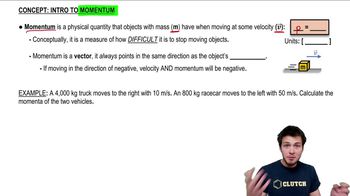
Momentum

Momentum is a vector quantity defined as the product of an object's mass and its velocity. In physics, it is crucial for understanding motion and interactions between objects. The momentum of a particle can change due to external forces, and it is conserved in isolated systems. The components of momentum can be analyzed in different reference frames, especially in relativistic contexts.
Recommended video:
Guided course
05:17
Intro to Momentum

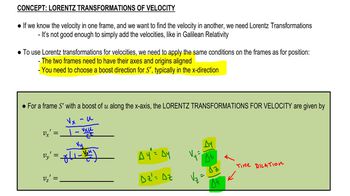
Lorentz Transformation

The Lorentz transformation is a set of equations that relate the space and time coordinates of two observers moving at constant velocity relative to each other. It accounts for the effects of special relativity, such as time dilation and length contraction. These transformations ensure that the laws of physics remain consistent across different inertial frames, particularly for quantities like position, time, and momentum.
Recommended video:
Guided course
13:39
Lorentz Transformations of Velocity

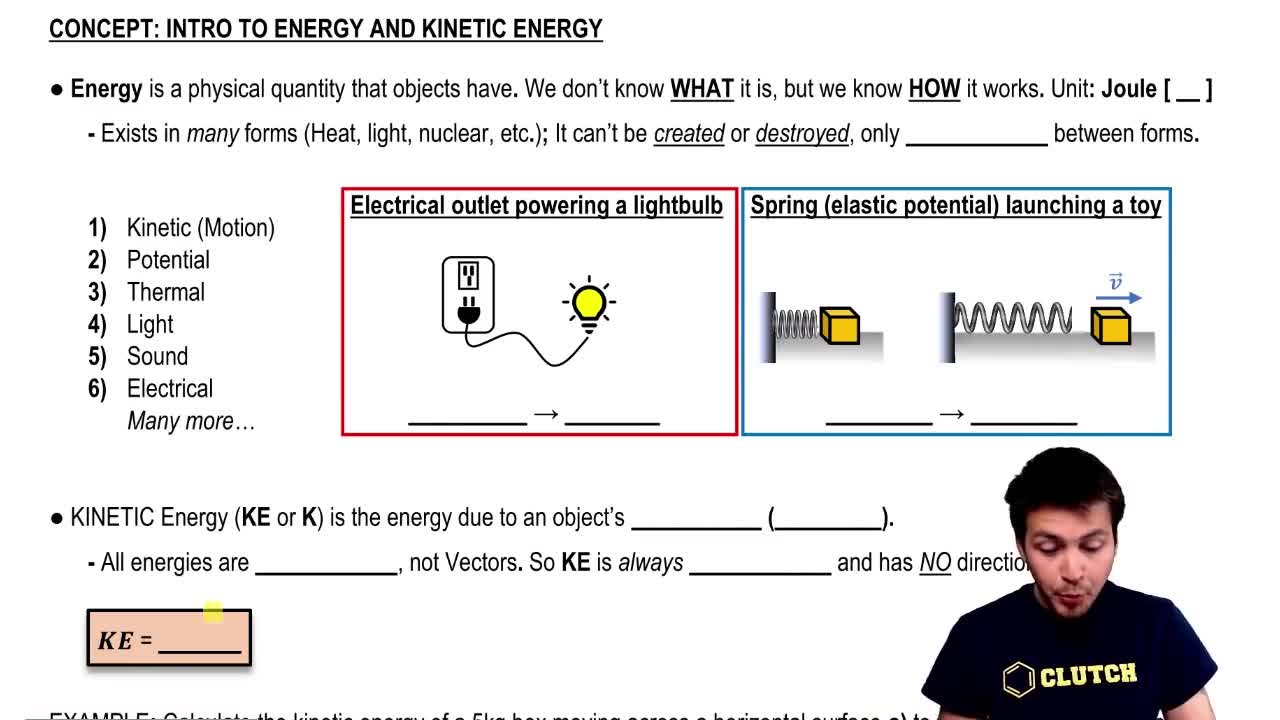
Relativistic Energy

Relativistic energy is the total energy of an object when accounting for its mass and motion at speeds close to the speed of light. It is expressed as E = mc² for rest energy and includes kinetic energy contributions from motion. In relativistic physics, energy and momentum are interconnected, and transformations must consider both to maintain conservation laws across different reference frames.
Recommended video:
Guided course
04:10
Intro to Energy & Types of Energy