Ch. 40 - Molecules and Solids
Giancoli Douglas - Physics for Scientists and Engineers 5th edition
Giancoli Douglas5th editionPhysics for Scientists and EngineersISBN: 9780137488179Not the one you use?Change textbook
Chapter 37, Problem 59

(III) A 120-V rms 60-Hz voltage is to be rectified with a full-wave rectifier as in Fig. 40–40, where R = 24 kΩ, and C = 35 μF. (a) Make a rough estimate of the average current. (b) What happens if C = 0.10 μF? [Hint: See Section 26–5.]

Verified step by step guidance
1
Step 1: Understand the problem. A full-wave rectifier converts an AC voltage into a DC voltage. The capacitor smooths the rectified voltage, and the resistor determines the current. The given parameters are: RMS voltage (V_rms) = 120 V, frequency (f) = 60 Hz, resistance (R) = 24 kΩ, and capacitance (C) = 35 μF (or 0.10 μF for part (b)). The goal is to estimate the average current and analyze the effect of changing the capacitance.
Step 2: Calculate the peak voltage (V_peak) of the AC source. The relationship between RMS voltage and peak voltage is given by: Vpeak=Vrms2. Substitute V_rms = 120 V to find V_peak.
Step 3: Estimate the average current (I_avg) using the relationship between the load resistor (R) and the rectified DC voltage. The average current can be approximated as: Iavg=Vpeak/R. Substitute the values of V_peak and R = 24 kΩ to calculate I_avg.
Step 4: Analyze the effect of the capacitor (C) on the smoothing of the rectified voltage. The capacitor smooths the voltage by reducing the ripple. The ripple voltage (ΔV) can be approximated using the formula: ∆V=Iavg/(fC). Substitute the values of I_avg, f = 60 Hz, and C = 35 μF to estimate the ripple voltage.
Step 5: Repeat the calculation of ripple voltage (ΔV) for C = 0.10 μF. Compare the results to understand how reducing the capacitance increases the ripple voltage, leading to less effective smoothing of the rectified voltage.

Verified video answer for a similar problem:

This video solution was recommended by our tutors as helpful for the problem above.
Video duration:
10m
Was this helpful?

Key Concepts

Here are the essential concepts you must grasp in order to answer the question correctly.

RMS Voltage

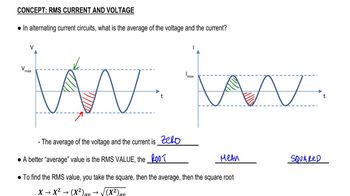
RMS (Root Mean Square) voltage is a statistical measure of the magnitude of a varying voltage. It represents the equivalent DC voltage that would deliver the same power to a load. For an AC voltage, the RMS value is calculated as the peak voltage divided by the square root of two. Understanding RMS voltage is crucial for analyzing AC circuits, especially when converting to DC using rectifiers.
Recommended video:
Guided course
07:14
RMS Current and Voltage

Full-Wave Rectification

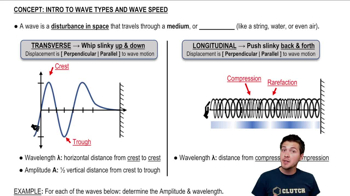
Full-wave rectification is a process that converts both halves of an AC waveform into a unidirectional output. This is typically achieved using a bridge rectifier, which allows current to flow during both the positive and negative cycles of the input voltage. The result is a smoother DC output compared to half-wave rectification, making it essential for applications requiring stable voltage.
Recommended video:
Guided course
07:19
Intro to Waves and Wave Speed

Capacitance and Filtering

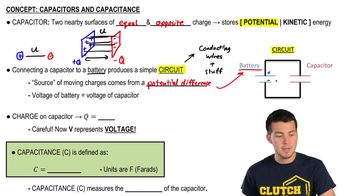
Capacitance in a rectifier circuit acts as a filter to smooth out the output voltage. A capacitor charges during the peaks of the rectified voltage and discharges during the troughs, reducing voltage fluctuations. The value of the capacitor significantly affects the output ripple voltage; a larger capacitance results in less ripple, while a smaller capacitance, like 0.10 μF, can lead to a more pronounced ripple and less stable output.
Recommended video:
Guided course
08:02
Capacitors & Capacitance (Intro)