
Ch. 30 - Inductance, Electromagnetic Oscillations, and AC Circuits
Giancoli Douglas - Physics for Scientists and Engineers 5th edition
Giancoli Douglas5th editionPhysics for Scientists and EngineersISBN: 9780137488179Not the one you use?Change textbook
Chapter 29, Problem 30.52

(II) A 25-mH coil whose resistance is 0.80 Ω is connected to a capacitor C and a 420-Hz source voltage. If the current and voltage are to be in phase, what value must C have?

Verified step by step guidance
1
Step 1: Understand that for the current and voltage to be in phase in an RLC circuit, the inductive reactance (XL) must equal the capacitive reactance (XC). The formula for inductive reactance is XL = 2\(\pi\) f L, where f is the frequency and L is the inductance.
Step 2: Calculate the inductive reactance using the given values: frequency (f = 420 Hz) and inductance (L = 25 mH = 0.025 H).
Step 3: Use the formula for capacitive reactance, which is XC = 1 / (2\(\pi\) f C), where C is the capacitance that needs to be calculated.
Step 4: Set the inductive reactance equal to the capacitive reactance (XL = XC) and solve for the capacitance C.
Step 5: Rearrange the equation to solve for C, which will be C = 1 / (2\(\pi\) f XL). Substitute the value of XL calculated in Step 2 to find the required capacitance.

Verified video answer for a similar problem:

This video solution was recommended by our tutors as helpful for the problem above.
Video duration:
3m
Was this helpful?

Key Concepts

Here are the essential concepts you must grasp in order to answer the question correctly.

Inductance and Resistance in RLC Circuits

In an RLC circuit, the inductance (L) and resistance (R) determine how the circuit responds to alternating current (AC). The inductance creates a magnetic field that opposes changes in current, while resistance dissipates energy. The relationship between these components affects the phase difference between voltage and current, which is crucial for understanding how to achieve in-phase conditions.
Recommended video:
Guided course
03:07
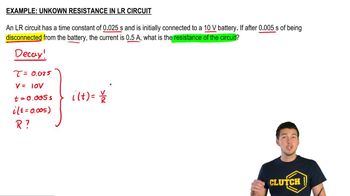
Unknown Resistance in an LR Circuit

Capacitance and Phase Relationship

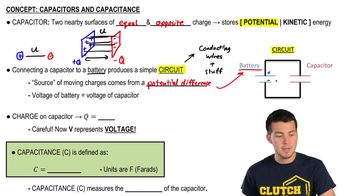
Capacitance (C) is the ability of a capacitor to store charge. In an AC circuit, the capacitor causes the current to lead the voltage by 90 degrees. To achieve a condition where the current and voltage are in phase, the capacitive reactance must equal the inductive reactance, which can be calculated using the frequency of the source and the values of L and C.
Recommended video:
Guided course
08:02
Capacitors & Capacitance (Intro)

Resonance in RLC Circuits

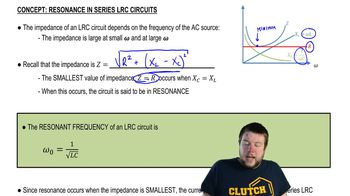
Resonance occurs in RLC circuits when the inductive reactance equals the capacitive reactance, resulting in maximum current flow and voltage being in phase. This condition is characterized by a specific frequency known as the resonant frequency. The formula for resonance involves the inductance and capacitance values, allowing for the calculation of the required capacitance to achieve resonance at a given frequency.
Recommended video:
Guided course
05:23
Resonance in Series LRC Circuits
Related Practice
Textbook Question

Two tightly wound solenoids have the same length and circular cross-sectional area. But solenoid 1 uses wire that is 1.5 times as thick as solenoid 2. What is the ratio of their inductive time constants? (Assume the only resistance in the circuits is that of the wire itself.)

97
views
Textbook Question

Two tightly wound solenoids have the same length and circular cross-sectional area. But solenoid 1 uses wire that is 1.5 times as thick as solenoid 2.

(a) What is the ratio of their inductances?

(b) What is the ratio of their inductive time constants? (Assume the only resistance in the circuits is that of the wire itself.)

1362
views
Textbook Question

A 10.0-k Ω resistor is in series with a 34.0-mH inductor and an ac source. Calculate the impedance of the circuit if the source frequency is (a) 55.0 Hz; (b) 55.0 kHz.

1179
views
Textbook Question

(II) Suppose that the U-shaped conductor and connecting rod in Fig. 29–12a are oriented vertically (but still in contact) so that the rod is falling due to the gravitational force. Find the terminal speed of the rod if it has mass m = 3.6 grams, length 𝓁 = 18 cm, and resistance R = 0.0013 Ω. It is falling in a uniform horizontal field B = 0.080 T. Neglect the resistance of the U-shaped conductor, and friction.

1460
views
Textbook Question

A 1.50-k Ω resistor in series with a 370-mH inductor is driven by an ac power supply. At what frequency is the impedance double that of the impedance at 60.0 Hz?

1449
views
Textbook Question

(II) A capacitor is placed in parallel with some device, B, as in Fig. 30–18b, to filter out stray high-frequency signals, but to allow ordinary 60.0-Hz ac to pass through with little loss. Suppose that circuit B in Fig. 30–18b is a resistance R = 530 Ω connected to ground, and that C = 0.35 μF. Calculate the ratio of the capacitor’s current amplitude to the incoming current’s amplitude if the incoming current has a frequency of (a) 60.0 Hz; (b) 60.0 kHz.

1230
views