Textbook Question
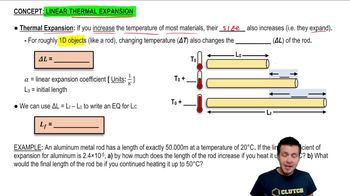
A brass plug is to be placed in a ring made of iron. At 15°C, the diameter of the plug is 8.756 cm and that of the inside of the ring is 8.742 cm. They must both be brought to what common temperature in order to fit?
1411
views

 Giancoli Douglas 5th editionCh. 17 - Temperature, Thermal Expansion, and the Ideal Gas LawProblem 24a
 Verified step by step guidance
 07:31
07:31
 09:18
09:18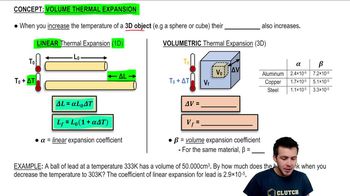 05:21
05:21A brass plug is to be placed in a ring made of iron. At 15°C, the diameter of the plug is 8.756 cm and that of the inside of the ring is 8.742 cm. They must both be brought to what common temperature in order to fit?
An aluminum bar has the desired length when at 12°C. How much stress is required to keep it at this length if the temperature increases to 38°C? [See Table 12–1.]
Water’s coefficient of volume expansion in the temperature range from 0°C to about 20°C is given approximately by β = α + bT + cT² , with α = - 6.43 x 10⁻⁵ (C°)⁻¹ , b = 1.70 x 10⁻⁵ (C°)⁻² , and c = -2.02 x 10⁻⁷ ((C°)⁻³. Using the formula for density from Problem 22, show that water has its greatest density at approximately 4.0°C.
The pendulum in a grandfather clock is made of brass and keeps perfect time at 17°C. How much time is gained or lost in a year if the clock is kept at 26°C? (Assume the frequency dependence on length for a simple pendulum applies; see Chapter 14.)
If a fluid is contained in a long narrow vessel so it can expand in essentially one direction only, show that the effective coefficient of linear expansion α is approximately equal to the coefficient of volume expansion β.
Wine bottles are never completely filled: a small volume of air is left in the glass bottle’s cylindrically shaped neck (inner diameter d = 18.5 mm) to allow for wine’s fairly large coefficient of thermal expansion. The distance H between the surface of the liquid contents and the bottom of the cork is called the “headspace height” (Fig. 17–22), and is typically H = 1.5 cm for a 750-mL bottle filled at 20°C. Due to its alcoholic content, wine’s coefficient of volume expansion is about double that of water; in comparison, the thermal expansion of glass can be neglected. Estimate H if the bottle is kept at 10°C.