
Ch. 09 - Linear Momentum
Giancoli Douglas - Physics for Scientists and Engineers 5th edition
Giancoli Douglas5th editionPhysics for Scientists and EngineersISBN: 9780137488179Not the one you use?Change textbook
Chapter 9, Problem 77

A 0.145-kg baseball pitched horizontally at 35.0 m/s strikes a bat and pops straight up to a height of 31.5 m. If the contact time between bat and ball is 2.5 ms, calculate the average force between the ball and bat during contact.

Verified step by step guidance
1
Step 1: Identify the initial and final velocities of the baseball. The initial velocity is given as 35.0 m/s horizontally. After the collision, the ball pops straight up, so its final vertical velocity can be determined using the kinematic equation for motion under gravity: 2gh, where g is the acceleration due to gravity (9.8 m/s²) and h is the height (31.5 m).
Step 2: Calculate the change in velocity. The initial velocity is horizontal, and the final velocity is vertical. Use vector addition to find the magnitude of the change in velocity: v2+u2, where v is the final vertical velocity and u is the initial horizontal velocity.
Step 3: Determine the change in momentum. Momentum is given by p=mv, where m is the mass of the baseball (0.145 kg) and v is the velocity. Calculate the change in momentum using the magnitude of the change in velocity from Step 2.
Step 4: Use the impulse-momentum theorem to relate the change in momentum to the average force. The theorem states FΔt=Δp, where F is the average force, Δt is the contact time (2.5 ms or 0.0025 s), and Δp is the change in momentum. Rearrange to solve for F: F=ΔpΔt.
Step 5: Substitute the values for the change in momentum and contact time into the equation from Step 4 to calculate the average force. Ensure all units are consistent (e.g., kilograms, meters per second, seconds).

Verified video answer for a similar problem:

This video solution was recommended by our tutors as helpful for the problem above.
Video duration:
6m
Was this helpful?

Key Concepts

Here are the essential concepts you must grasp in order to answer the question correctly.

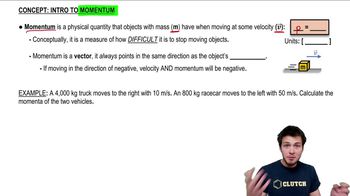
Momentum

Momentum is the product of an object's mass and its velocity, represented by the equation p = mv. In this scenario, the baseball's momentum before and after the collision with the bat is crucial for understanding the changes in motion. The change in momentum during the impact can help determine the average force exerted by the bat on the ball.
Recommended video:
Guided course
05:17
Intro to Momentum

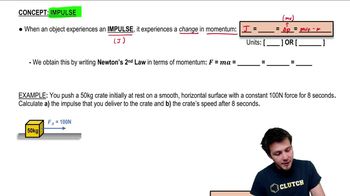
Impulse

Impulse is defined as the change in momentum of an object when a force is applied over a period of time, expressed as J = FΔt. In this case, the impulse experienced by the baseball during its brief contact with the bat will allow us to calculate the average force exerted. The relationship between impulse and force is essential for solving the problem.
Recommended video:
Guided course
06:00
Impulse & Impulse-Momentum Theorem

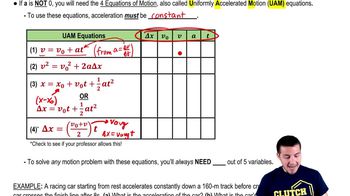
Kinematics

Kinematics is the branch of physics that describes the motion of objects without considering the forces that cause the motion. In this problem, kinematic equations can be used to analyze the vertical motion of the baseball after it leaves the bat, particularly to find the initial velocity needed to reach a height of 31.5 m. Understanding kinematics is vital for connecting the motion of the baseball to the forces involved.
Recommended video:
Guided course
08:25
Kinematics Equations
Related Practice
Textbook Question

A gun fires a bullet vertically into a 1.40-kg block of wood at rest on a thin horizontal sheet, Fig. 9–54. If the bullet has a mass of 15.0 g and a speed of 230 m/s, how high will the block rise into the air after the bullet becomes embedded in it?

1646
views
Textbook Question

A rocket traveling 1950 m/s away from the Earth at an altitude of 6400 km fires its rockets, which eject gas at a speed of 1200 m/s (relative to the rocket). If the mass of the rocket at this moment is 25,000 kg and an acceleration of 1.5 m/s² is desired, at what rate must the gases be ejected?

130
views
Textbook Question

A 5.5-kg object moving in the +𝓍 direction at 6.5 m/s collides head-on with an 8.0-kg object moving in the ―𝓍 direction at 4.0 m/s. Determine the final velocity of each object if the collision is elastic.

1283
views
Textbook Question

Find the center of mass of the ammonia molecule. The chemical formula is NH₃. The hydrogens are at the corners of an equilateral triangle (with sides 0.16 nm) that forms the base of a pyramid, with nitrogen at the apex (0.037 nm vertically above the plane of the triangle).

1599
views
Textbook Question

A 5.5-kg object moving in the +𝓍 direction at 6.5 m/s collides head-on with an 8.0-kg object moving in the ―𝓍 direction at 4.0 m/s. Determine the final velocity of each object if the objects stick together.

1395
views
Textbook Question

A huge balloon and its gondola, of mass M, are in the air and stationary with respect to the ground. A passenger, of mass m, then climbs out and slides down a rope with speed v, measured with respect to the balloon. With what speed and direction (relative to Earth) does the balloon then move? What happens if the passenger stops?

1592
views