

Ch. 21 - Electric Charge and Electric Field
Giancoli Douglas - Physics for Scientists and Engineers 5th edition
Giancoli Douglas5th editionPhysics for Scientists and EngineersISBN: 9780137488179Not the one you use?Change textbook
Chapter 21, Problem 38

Draw, approximately, the electric field lines emanating from a uniformly charged straight wire whose length ℓ is not great. The spacing between lines near the wire should be much less than ℓ. [Hint: Also consider points very far from the wire up to 4ℓ \.]

Verified step by step guidance
1
Understand the problem: The goal is to sketch the electric field lines around a uniformly charged straight wire of finite length ℓ. The electric field lines represent the direction and relative strength of the electric field at various points around the wire.
Recall the concept of electric field lines: Electric field lines start on positive charges and end on negative charges (or extend to infinity if the charge is isolated). The density of the lines indicates the strength of the electric field, and the lines are perpendicular to the surface of the charged object.
Near the wire: Close to the wire, the electric field lines will radiate outward perpendicularly from the surface of the wire. Since the wire is uniformly charged, the spacing between the lines near the wire will be uniform and relatively dense, indicating a strong electric field.
Far from the wire: At distances much greater than the length of the wire (e.g., at distances around 4ℓ), the wire can be approximated as a point charge. The electric field lines will appear to radiate outward in a radial pattern, similar to the field of a point charge, and the spacing between the lines will increase as the distance from the wire increases.
Sketch the field lines: Draw the electric field lines starting perpendicularly from the surface of the wire and spreading outward. Near the wire, the lines should be dense and evenly spaced. As you move farther away, the lines should spread out and transition into a radial pattern, resembling the field of a point charge at large distances.

Verified video answer for a similar problem:

This video solution was recommended by our tutors as helpful for the problem above.
Video duration:
6m
Was this helpful?

Key Concepts

Here are the essential concepts you must grasp in order to answer the question correctly.

Electric Field

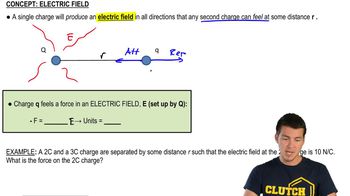
An electric field is a region around a charged object where other charged objects experience a force. It is represented by field lines that indicate the direction and strength of the force. The density of these lines corresponds to the strength of the field; closer lines indicate a stronger field. For a straight wire, the electric field lines radiate outward in a cylindrical pattern.
Recommended video:
Guided course
03:16
Intro to Electric Fields

Uniform Charge Distribution

Uniform charge distribution refers to a scenario where charge is spread evenly along a conductor or surface. In the case of a straight wire, this means that the charge density is constant along its length. This uniformity simplifies the analysis of the electric field, allowing for predictable patterns in the field lines, which are symmetrical around the wire.
Recommended video:
Guided course
04:03
Probability Distribution Graph

Field Line Representation

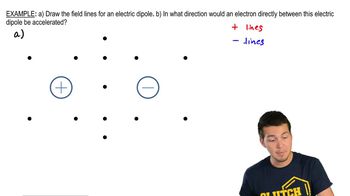
Field line representation is a visual tool used to illustrate electric fields. Lines are drawn to show the direction of the electric field (from positive to negative charges) and their density indicates the strength of the field. For a uniformly charged wire, the lines will be straight and radial, becoming less dense as the distance from the wire increases, particularly at points far from the wire.
Recommended video:
Guided course
08:20
Electric Field Lines