
(II) Two long parallel wires 8.20 cm apart carry 19.5-A dc currents in the same direction. Determine the magnetic field vector at a point P, 12.0 cm from one wire and 13.0 cm from the other. See Fig. 28–43. [Hint: Use the law of cosines. See Appendix A or inside rear cover.]
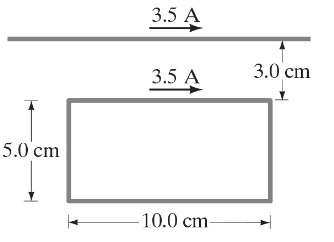
"(II) A rectangular loop of wire is placed next to a straight wire, as shown in Fig. 28–40. There is a dc current of 3.5 A in both wires. Determine the magnitude and direction of the net force on the loop.

Verified step by step guidance
Verified video answer for a similar problem:
Key Concepts
Magnetic Field Due to a Current-Carrying Wire
Lorentz Force
Superposition of Forces
(II) Two long straight wires each carry a dc current I out of the page toward the viewer, Fig. 28–38. Indicate, with appropriate arrows, the direction of at each of the points 1 to 6 in the plane of the page. State if the field is zero at any of the points.
(II) Two long thin parallel wires 13.0 cm apart carry 25-A currents in the same direction. Determine the magnetic field vector at a point 10.0 cm from one wire and 6.0 cm from the other (Fig. 28–37). [Hint: You could try using the law of cosines, Appendix A.]
(II) Two long wires are oriented so that they are perpendicular to each other. At their closest, they are 20.0 cm apart (Fig. 28–42). What is the magnitude of the magnetic field at a point midway between them if the top one carries a current of 18.0 A and the bottom one carries 12.0 A?
(II) In Fig. 28–36, a long straight wire carries current I out of the page toward you. Indicate, with appropriate arrows, the direction and (relative) magnitude of at each of the points C, D, and E in the plane of the page.
(II) Let two long parallel wires, a distance d apart, carry equal dc currents I in the same direction. One wire is at 𝓍 = 0, the other at 𝓍 = d, Fig. 28–41. Determine along the 𝓍 axis between the wires as a function of 𝓍.
