
Ch. 20 - Second Law of Thermodynamics
Giancoli Douglas - Physics for Scientists and Engineers 5th edition
Giancoli Douglas5th editionPhysics for Scientists and EngineersISBN: 9780137488179Not the one you use?Change textbook
Chapter 20, Problem 25

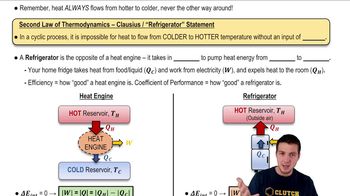
(II) What is the temperature inside an ideal refrigerator–freezer that operates with a COP = 7.0 in a 22°C room?

Verified step by step guidance
1
Understand the problem: The Coefficient of Performance (COP) for a refrigerator is defined as the ratio of the heat removed from the cold reservoir (Q_c) to the work input (W). Mathematically, COP = Q_c / W. For an ideal refrigerator, the COP can also be expressed in terms of the temperatures of the cold reservoir (T_c) and the hot reservoir (T_h) as COP = T_c / (T_h - T_c), where temperatures are in Kelvin.
Convert the given room temperature (T_h) from Celsius to Kelvin. Use the formula T(K) = T(°C) + 273.15. For the room temperature of 22°C, calculate T_h in Kelvin.
Rearrange the formula for COP to solve for the cold reservoir temperature (T_c). The formula becomes T_c = COP × (T_h - T_c).
Substitute the given COP value (7.0) and the calculated T_h into the equation. Solve algebraically for T_c. This will involve isolating T_c on one side of the equation.
Once T_c is calculated in Kelvin, convert it back to Celsius using the formula T(°C) = T(K) - 273.15 to find the temperature inside the refrigerator-freezer.

Verified video answer for a similar problem:

This video solution was recommended by our tutors as helpful for the problem above.
Video duration:
5m
Was this helpful?

Key Concepts

Here are the essential concepts you must grasp in order to answer the question correctly.

Coefficient of Performance (COP)

The Coefficient of Performance (COP) is a measure of the efficiency of a refrigeration system. It is defined as the ratio of the heat removed from the refrigerated space to the work input required to remove that heat. A higher COP indicates a more efficient refrigerator, meaning it can remove more heat for each unit of work done.
Recommended video:
Guided course
06:47
Refrigerators

Thermodynamics of Refrigeration

Refrigeration operates based on the principles of thermodynamics, particularly the second law, which states that heat naturally flows from hot to cold. Refrigerators use a refrigerant that absorbs heat from the interior and releases it outside, effectively lowering the temperature inside. Understanding this process is crucial for calculating the internal temperature based on external conditions and COP.
Recommended video:
Guided course
06:47
Refrigerators

Absolute Temperature Scale

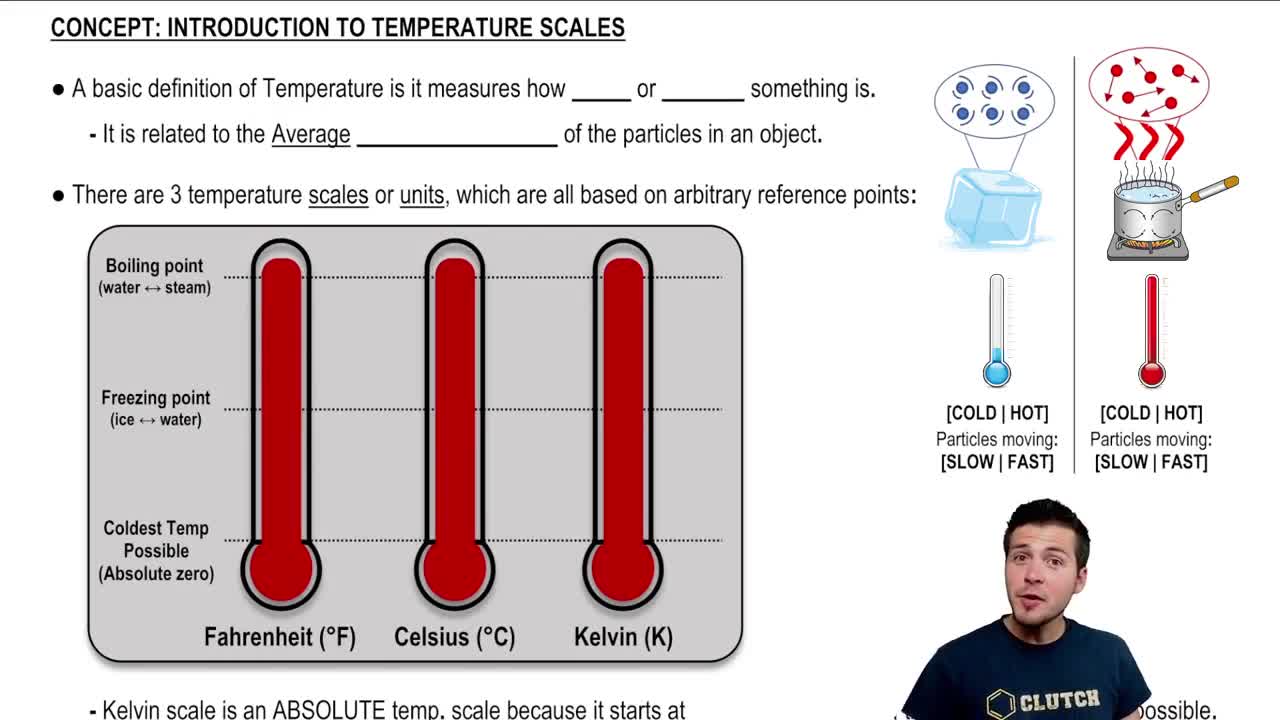
The absolute temperature scale, measured in Kelvin (K), is essential for thermodynamic calculations. To convert Celsius to Kelvin, you add 273.15. This scale is used in thermodynamic equations to ensure that temperature values are always positive, which is necessary for accurate calculations involving energy and heat transfer.
Recommended video:
Guided course
04:54
Introduction To Temperature Scales
Related Practice
Textbook Question

An ideal heat pump is used to maintain the inside temperature of a house at Tᵢₙ = 22°C when the outside temperature is Tₒᵤₜ. Assume the heat pump does work at a rate of 1700 W. Also assume that the house loses heat via conduction through its walls and other surfaces at a rate given by ( 650 W/C°) (Tᵢₙ - Tₒᵤₜ). If the outside temperature is less than you just calculated, what happens?

1050
views
Textbook Question

One mole of monatomic gas undergoes a Carnot cycle with TH = 350°C and TL = 210°C. The initial pressure is 8.8 atm. During the isothermal expansion, the volume doubles. Calculate the efficiency of the cycle using Eqs. 20–1 and 20–3.

1239
views
Textbook Question

One mole of monatomic gas undergoes a Carnot cycle with TH = 350°C and TL = 210°C. The initial pressure is 8.8 atm. During the isothermal expansion, the volume doubles. Find the values of the pressure and volume at the points a, b, c, and d of Fig. 20–5.

1234
views
Textbook Question

(II) 1.00 mole of nitrogen (N₂) gas and 1.00 mole of argon (Ar) gas are in separate, equal-sized, insulated containers at the same temperature. The containers are then connected and the gases (assumed ideal) allowed to mix. What is the change in entropy

(a) of the system

1409
views
Textbook Question

What is the coefficient of performance of an ideal heat pump that extracts heat from 6°C air outside and deposits heat inside a house at 24°C?

1505
views
Textbook Question

How much less per year would it cost a family to operate a heat pump that has a coefficient of performance of 2.9 than an electric heater that costs \$2100 to heat their home for a year? If the conversion to the heat pump costs \$15,000, how long would it take the family to break even on heating costs? How much would the family save in 20 years?

1189
views