
Ch. 23 - Electric Potential
Giancoli Douglas - Physics for Scientists and Engineers 5th edition
Giancoli Douglas5th editionPhysics for Scientists and EngineersISBN: 9780137488179Not the one you use?Change textbook
Chapter 22, Problem 45

Calculate the electric potential due to a tiny dipole whose dipole moment is 4.8 x 10⁻³⁰ Cm at a point 4.1 x 10⁻⁹ m away if this point is along the axis of the dipole nearer the positive charge.

Verified step by step guidance
1
Understand the concept: The electric potential due to a dipole at a point along its axis is given by the formula: V=1qp4pi........

Verified video answer for a similar problem:

This video solution was recommended by our tutors as helpful for the problem above.
Video duration:
3m
Was this helpful?

Key Concepts

Here are the essential concepts you must grasp in order to answer the question correctly.

Electric Dipole

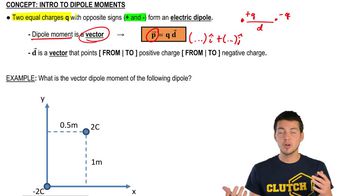
An electric dipole consists of two equal and opposite charges separated by a small distance. The dipole moment, a vector quantity, is defined as the product of the charge and the distance between the charges. It characterizes the strength and orientation of the dipole in an electric field, influencing the potential and field created by the dipole.
Recommended video:
Guided course
03:08
Intro To Dipole Moment

Electric Potential

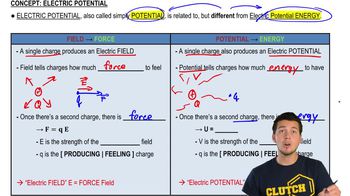
Electric potential is the amount of electric potential energy per unit charge at a point in an electric field. It indicates how much work would be done to move a charge from a reference point to the specified point without any acceleration. For a dipole, the potential varies with distance and angle relative to the dipole axis, and is calculated using specific formulas depending on the position of the point of interest.
Recommended video:
Guided course
07:33
Electric Potential

Distance from the Dipole

The distance from the dipole is crucial in determining the electric potential at a given point. The potential due to a dipole decreases with increasing distance, following an inverse cube relationship for points along the dipole axis. Understanding how this distance affects the potential is essential for accurately calculating the electric potential at specified locations relative to the dipole.
Recommended video:
Guided course
03:08
Intro To Dipole Moment