Ch. 24 - Capacitance, Dielectrics, Electric Energy, Storage
Giancoli Douglas - Physics for Scientists and Engineers 5th edition
Giancoli Douglas5th editionPhysics for Scientists and EngineersISBN: 9780137488179Not the one you use?Change textbook
Chapter 23, Problem 98a

In lightning storms, the potential difference between the Earth and the bottom of the thunderclouds can be as high as 35,000,000 V. The bottoms of thunderclouds are typically 1500 m above the Earth, and can have an area of 110 km². Modeling the Earth–cloud system as a huge capacitor, calculate the capacitance of the Earth–cloud system,

Verified step by step guidance
1
Model the Earth-cloud system as a parallel plate capacitor. The capacitance of a parallel plate capacitor is given by the formula: C=εdA, where ε is the permittivity of free space (ε=8.85×10⁻¹² F/m), A is the area of the plates, and d is the separation between the plates.
Convert the area of the thunderclouds from square kilometers to square meters. Since 1 km²=106 m², multiply 110 km² by 106 to get the area in square meters.
Substitute the values into the capacitance formula. Use ε=8.85×10⁻¹² F/m, the converted area A, and the separation distance d=1500 m.
Simplify the expression to calculate the capacitance. Ensure that the units are consistent throughout the calculation, and the result will be in farads (F).
Interpret the result. The capacitance of the Earth-cloud system represents the ability of this system to store charge for a given potential difference.

Verified video answer for a similar problem:

This video solution was recommended by our tutors as helpful for the problem above.
Video duration:
2m
Was this helpful?

Key Concepts

Here are the essential concepts you must grasp in order to answer the question correctly.

Capacitance

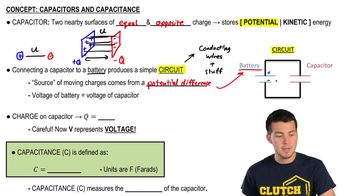
Capacitance is a measure of a capacitor's ability to store electric charge per unit voltage. It is defined as the ratio of the electric charge stored (Q) to the potential difference (V) across the capacitor, expressed as C = Q/V. In the context of the Earth-cloud system, capacitance can be modeled using the area of the cloud and the distance to the Earth, allowing us to understand how much charge can be stored given a specific voltage.
Recommended video:
Guided course
08:02
Capacitors & Capacitance (Intro)

Electric Field

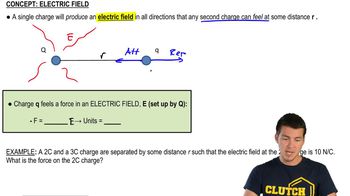
The electric field (E) is a vector field that represents the force per unit charge experienced by a positive test charge placed in the field. It is related to the potential difference and the distance over which it acts, given by E = V/d. In the case of the Earth-cloud system, the electric field can be calculated using the potential difference between the cloud and the Earth, which helps in understanding the forces at play during a lightning storm.
Recommended video:
Guided course
03:16
Intro to Electric Fields

Area and Distance in Capacitors

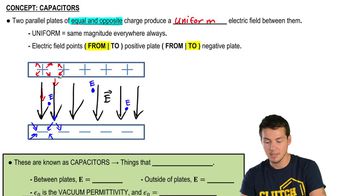
In capacitor theory, the capacitance is influenced by the area of the plates and the distance between them. For parallel plate capacitors, capacitance increases with larger plate area and decreases with greater separation. In the Earth-cloud model, the area of the thundercloud and the height above the Earth are critical parameters that determine the effective capacitance, impacting the system's ability to store charge and the potential for lightning discharge.
Recommended video:
Guided course
06:13
Intro to Capacitors