
The head of a hammer with a mass of 1.2 kg is allowed to fall onto a nail from a height of 0.65 m. What is the maximum amount of work it could do on the nail? Why do people not just “let it fall” but add their own force to the hammer as it falls?
A 2.0-kg block slides across a rough surface with a constant coefficient of kinetic friction of 0.50 (Fig. 7–38a). The block starts at x= 0 with an initial velocity of 4.9 m/s. Pushing the block is a force directed at 36.8° below the horizontal and whose magnitude increases with position as shown in Fig. 7–38b.
<IMAGE>
(d) Draw a line on the graph showing the magnitude of the friction force versus distance x.
Verified step by step guidance
Verified video answer for a similar problem:
Key Concepts
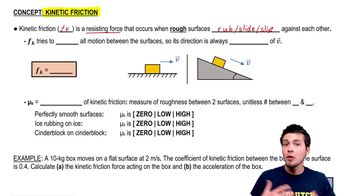
Kinetic Friction
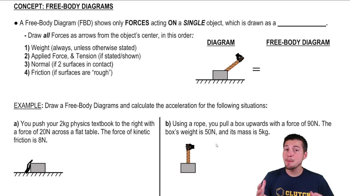
Free Body Diagram
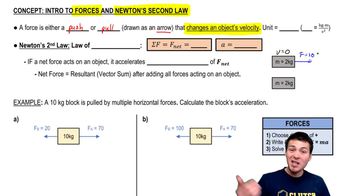
Newton's Second Law
Estimate the work you do to mow a lawn 10 m by 20 m with a 50-cm-wide mower. Assume you push with a horizontal force of about 15 N.
A 55.0-kg firefighter climbs a flight of stairs 28.0 m high at constant speed. How much work does she do?
In a certain library the first shelf is 15.0 cm off the ground, and the remaining four shelves are each spaced 38.0 cm above the previous one. If the average book has a mass of 1.25 kg with a height of 22.0 cm, and an average shelf holds 28 books (standing vertically), how much work is required to fill all the shelves, assuming the books are all laying flat on the floor to start?
A grocery cart with mass of 16 kg is pushed at constant speed up a 12° ramp by a force FP which acts at an angle of 17° below the horizontal. Find the work done by each of the forces (m, , ) on the cart if the ramp is 7.5 m long.
