
Ch. 15 - Wave Motion
Giancoli Douglas - Physics for Scientists and Engineers 5th edition
Giancoli Douglas5th editionPhysics for Scientists and EngineersISBN: 9780137488179Not the one you use?Change textbook
Chapter 15, Problem 76

Destructive interference occurs where two overlapping waves are 1/2 wavelength or 180° out of phase. Explain why 180° is equivalent to 1/2 wavelength.

Verified step by step guidance
1
Understand the concept of phase difference: The phase difference between two waves describes how 'in sync' or 'out of sync' they are. A full cycle of a wave corresponds to 360° (or 2π radians), which is equivalent to one full wavelength (λ).
Relate phase difference to wavelength: A phase difference of 180° (or π radians) represents half of a full cycle. Since one full cycle corresponds to one wavelength, half a cycle corresponds to half a wavelength (λ/2).
Visualize the wave relationship: When two waves are 180° out of phase, the crest of one wave aligns with the trough of the other wave. This alignment causes destructive interference, as the positive displacement of one wave cancels out the negative displacement of the other.
Express mathematically: The relationship between phase difference (Δϕ) and wavelength (λ) can be written as Δϕ = (2π/λ) × Δx, where Δx is the path difference. For Δϕ = π (180°), the path difference Δx = λ/2.
Conclude the equivalence: Therefore, a phase difference of 180° is equivalent to a path difference of half a wavelength (λ/2), which explains why destructive interference occurs under these conditions.

Verified video answer for a similar problem:

This video solution was recommended by our tutors as helpful for the problem above.
Video duration:
4m
Was this helpful?

Key Concepts

Here are the essential concepts you must grasp in order to answer the question correctly.

Wavelength

Wavelength is the distance between successive crests or troughs of a wave. It is a fundamental property of waves, denoted by the Greek letter lambda (λ). In the context of sound or light waves, the wavelength determines the wave's frequency and energy, influencing how the wave interacts with matter.
Recommended video:
Guided course
05:42
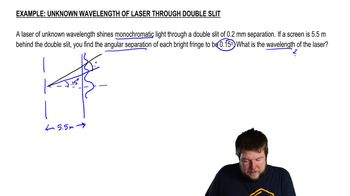
Unknown Wavelength of Laser through Double Slit

Phase Difference

Phase difference refers to the difference in the phase of two waves at a given point in time. It is measured in degrees or radians, with a full cycle of a wave corresponding to 360° or 2π radians. A phase difference of 180° indicates that the waves are perfectly out of sync, leading to destructive interference when they overlap.
Recommended video:
Guided course
08:59
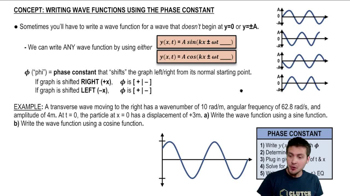
Phase Constant of a Wave Function

Destructive Interference

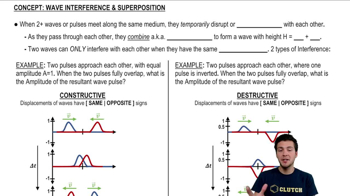
Destructive interference occurs when two waves meet in such a way that their crests align with the troughs of the other, effectively canceling each other out. This phenomenon happens when the waves are 180° out of phase, which corresponds to a half-wavelength difference. The result is a reduction in amplitude, leading to a lower intensity of the resultant wave.
Recommended video:
Guided course
03:47
Wave Interference & Superposition
Related Practice
Textbook Question

An earthquake-produced surface wave can be approximated by a sinusoidal transverse wave. Assuming a frequency of 0.60 Hz (typical of earthquakes, which actually include a mixture of frequencies), what amplitude is needed so that objects begin to leave contact with the ground? [Hint: Set the acceleration a > g. Why?]-

1232
views
Textbook Question

A guitar string is supposed to vibrate at 247 Hz, but is measured to actually vibrate at 262 Hz. By what percentage should the tension in the string be changed to get the frequency to the correct value?

1209
views
Textbook Question

Two strings on a musical instrument are tuned to play at 392 Hz (G) and 494 Hz (B). What are the frequencies of the first two overtones for each string?

963
views
Textbook Question

A bug on the surface of a pond is observed to move up and down a total vertical distance of 0.10 m, lowest to highest point, as a wave passes. If the amplitude increases to 0.15 m, by what factor does the bug’s maximum kinetic energy change?

945
views
Textbook Question

A longitudinal earthquake wave strikes a boundary between two types of rock at a 41° angle. As the wave crosses the boundary, the specific gravity of the rock changes from 3.6 to 2.8. Assuming that the elastic modulus (Section 15–2)is the same for both types of rock, determine the angle of refraction.

1263
views
Textbook Question

A transverse wave pulse travels to the right along a string with a speed v = 2.4 m/s. At t = 0 the shape of the pulse is given by the function D = 4.0m³ / (x² + 2.0m²), where D and x are in meters. Determine a formula for the wave pulse at any time t assuming the pulse is traveling to the left.

1162
views