
Helmholtz coils are two identical circular coils having the same radius 𝑅 and the same number of turns N, separated by a distance equal to the radius 𝑅 and carrying the same dc current I in the same direction. (See Fig. 28–61.) They are used in scientific instruments to generate nearly uniform magnetic fields. (They can be seen in the photo, Fig. 27–19.) (a) Determine the magnetic field B at points 𝓍 along the line joining their centers. Let 𝓍 = 0 at the center of one coil, and 𝓍 = 𝑅 at the center of the other. (b) Show that the field midway between the coils is particularly uniform by showing that dB/d𝓍 = 0 and d²B/d𝓍² = 0 at the midpoint between the coils. (c) If 𝑅 = 10.0 cm, N = 85 turns and I = 3.0 A, what is the field at the midpoint between the coils, 𝓍 = 𝑅/2?

- Ch. 01 - Introduction, Measurement, Estimating10
- Ch. 02 - Describing Motion: Kinematics in One Dimension30
- Ch. 03 - Kinematics in Two or Three Dimensions; Vectors15
- Ch. 04 - Dynamics: Newton's Laws of Motion16
- Ch. 05 - Using Newton's Laws: Friction, Circular Motion, Drag Forces22
- Ch. 06 - Gravitation and Newton's Synthesis10
- Ch. 07 - Work and Energy21
- Ch. 08 - Conservation of Energy33
- Ch. 09 - Linear Momentum26
- Ch. 10 - Rotational Motion41
- Ch. 11 - Angular Momentum; General Rotation27
- Ch. 12 - Static Equilibrium; Elasticity and Fracture27
- Ch. 13 - Fluids28
- Ch. 14 - Oscillations14
- Ch. 15 - Wave Motion35
- Ch. 16 - Sound5
- Ch. 17 - Temperature, Thermal Expansion, and the Ideal Gas Law40
- Ch. 18 - Kinetic Theory of Gases18
- Ch. 19 - Heat and the First Law of Thermodynamics31
- Ch. 20 - Second Law of Thermodynamics32
- Ch. 21 - Electric Charge and Electric Field7
- Ch. 23 - Electric Potential20
- Ch. 24 - Capacitance, Dielectrics, Electric Energy, Storage15
- Ch. 25 - Electric Current and Resistance32
- Ch. 26 - DC Circuits22
- Ch. 27 - Magnetism21
- Ch. 28 - Sources of Magnetic Field24
- Ch. 29 - Electromagnetic Induction and Faraday's Law21
- Ch. 30 - Inductance, Electromagnetic Oscillations, and AC Circuits42
- Ch. 31 - Maxwell's Equations and Electromagnetic Waves25
- Ch. 32 - Light: Reflection and Refraction42
- Ch. 33 - Lenses and Optical Instruments21
- Ch. 34 - The Wave Nature of Light: Interference and Polarization26
- Ch. 35 - Diffraction24
- Ch. 36 - The Special Theory of Relativity29
- Ch. 38 - Quantum Mechanics1
- Ch. 40 - Molecules and Solids6
- Ch. 43 - Elementary Particles3
- Ch. 44 - Astrophysics and Cosmology9
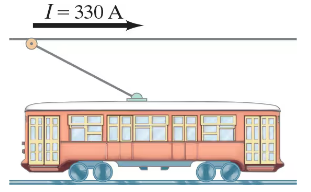
The power cable for an electric trolley (Fig. 27–60) carries a horizontal current of 330 A toward the east. The Earth’s magnetic field has a strength 5.0 x 10⁻⁵ T and makes an angle of dip of 22° at this location. Calculate the magnitude and direction of the magnetic force on a 15-m length of this cable.
 Verified step by step guidance
Verified video answer for a similar problem:

Key Concepts
Magnetic Force on a Current-Carrying Conductor
Earth's Magnetic Field
Right-Hand Rule
Part of a long, thin insulated straight wire is formed into a single circular loop of radius 𝑅 (Fig. 28–68) and carries a current I. (a) What is the magnitude and direction of the magnetic field at the center of the loop? (b) If the plane of the loop is twisted 90 degrees so that the plane is perpendicular to the straight part of the wire (i.e., in the yz plane) what is the magnitude and direction of the field now at the center of the loop?
You want to get an idea of the magnitude of magnetic fields produced by overhead power lines. You estimate that a transmission wire is about 12 m above the ground. The local power company tells you that the lines operate at 145 kV and provide a maximum of 45 MW to the local area. Estimate the maximum magnetic field you might experience walking under one such power line, and compare to the Earth’s field. [For an ac current, values are rms, and the magnetic field will be changing.]
A toroid is fabricated with a circular shape and loops with a square cross section as shown in Fig. 28–69. The cross-section of a loop is a square of side 6.0 cm. The inner radius of the whole circular toroid is 3.0 m. There are 320 loops of wire which carry a 45-A dc current using a nearby power supply at 20.0 V. The arrows show the current flow in and out of the toroid. The current flows up at the inner diameter and down at the outer diameter. (a) Calculate the strength of the magnetic field at the center of the square’s cross section at point P. (b) Is the magnetic field pointing clockwise or counterclockwise? (c) The square cross-sectional area of the wire is uniformly 0.10 cm2. What is the resistivity of the wire?
A set of Helmholtz coils (see Problem 62, Fig. 28–61) have a radius 𝑅 = 10.0 cm and are separated by a distance 𝑅 = 10.0 cm . Each coil has 85 loops carrying a current I = 2.0 A. Graph B as a function of 𝓍.
Two long straight aluminum wires, each of diameter 0.42 mm, carry the same current but in opposite directions. They are suspended by 0.50-m-long strings as shown in Fig. 28–66. If the suspension strings make an angle of 3.0° with the vertical and are hanging freely, what is the current in the wires?