Ch. 15 - Wave Motion
Giancoli Douglas - Physics for Scientists and Engineers 5th edition
Giancoli Douglas5th editionPhysics for Scientists and EngineersISBN: 9780137488179Not the one you use?Change textbook
Chapter 15, Problem 77

An earthquake-produced surface wave can be approximated by a sinusoidal transverse wave. Assuming a frequency of 0.60 Hz (typical of earthquakes, which actually include a mixture of frequencies), what amplitude is needed so that objects begin to leave contact with the ground? [Hint: Set the acceleration a > g. Why?]-

Verified step by step guidance
1
Understand the problem: Objects will leave contact with the ground when the upward acceleration of the wave exceeds the acceleration due to gravity (g = 9.8 m/s²). This happens when the maximum acceleration of the wave, given by the sinusoidal motion, is greater than g.
The general equation for the displacement of a sinusoidal wave is: x(t) = A sin(2πft), where A is the amplitude, f is the frequency, and t is time. The acceleration is the second derivative of displacement with respect to time.
Take the second derivative of the displacement equation to find the acceleration: a(t) = -A(2πf)2 sin(2πft). The maximum acceleration occurs when sin(2πft) = ±1, so the maximum acceleration is amax = A(2πf)2.
Set the condition for objects leaving the ground: amax > g. Substituting the expression for amax, we get A(2πf)2 > g.
Solve for the amplitude A: Rearrange the inequality to isolate A: A > g / (2πf)2. Substitute the given values for g = 9.8 m/s² and f = 0.60 Hz to find the required amplitude.

Verified video answer for a similar problem:

This video solution was recommended by our tutors as helpful for the problem above.
Video duration:
3m
Was this helpful?

Key Concepts

Here are the essential concepts you must grasp in order to answer the question correctly.

Transverse Waves

Transverse waves are waves in which the particle displacement is perpendicular to the direction of wave propagation. In the context of earthquakes, surface waves can be modeled as transverse waves, where the ground moves up and down while the wave travels horizontally. Understanding this concept is crucial for analyzing how these waves affect structures and the ground.
Recommended video:
Guided course
07:32
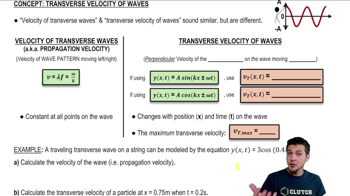
Transverse Velocity of Waves

Acceleration and Gravity

Acceleration refers to the rate of change of velocity of an object. In this scenario, the hint suggests setting the wave's acceleration greater than the acceleration due to gravity (g ≈ 9.81 m/s²). This is important because if the upward acceleration of the wave exceeds gravitational pull, objects on the ground will lose contact and potentially become airborne.
Recommended video:
Guided course
05:20
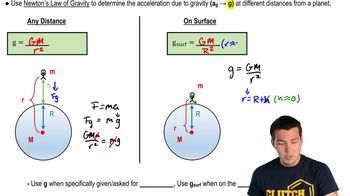
Acceleration Due to Gravity

Amplitude of a Wave

Amplitude is the maximum displacement of points on a wave from its rest position, indicating the wave's energy. In the case of seismic waves, a larger amplitude means a stronger wave, which can lead to greater ground motion. To determine the amplitude required for objects to leave the ground, one must calculate the necessary acceleration based on the wave's frequency and the relationship between amplitude and wave motion.
Recommended video:
Guided course
07:19
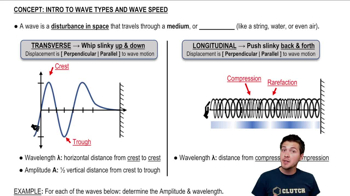
Intro to Waves and Wave Speed