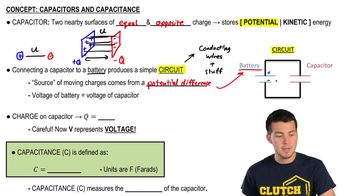
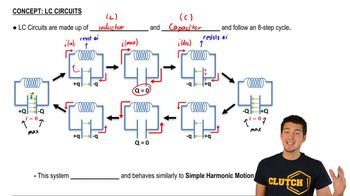
In some experiments, very tiny distances or spaces ( ≈ nm ) can be measured by using capacitance. Consider forming an LC circuit using a parallel-plate capacitor with plate area A, and a known inductance L. If charge is found to oscillate in this circuit at frequency f = ω/2π when the capacitor plates are separated by distance x, show that x = 4π² Aε₀f²L.
Giancoli Douglas 5th edition
Ch. 30 - Inductance, Electromagnetic Oscillations, and AC Circuits
Problem 84cIn some experiments, very tiny distances or spaces ( ≈ nm ) can be measured by using capacitance. Consider forming an LC circuit using a parallel-plate capacitor with plate area A, and a known inductance L. If f is on the order of 1 MHz and can be measured to a precision of ∆f = 1 Hz, with what percent accuracy can x be determined? Assume fringing effects at the capacitor’s edges can be neglected.
Verified step by step guidance
Verified video answer for a similar problem:
Key Concepts
Capacitance
LC Circuit
Frequency Measurement Precision
Show that if the inductor L in the filter circuit of Fig. 30–33 (Problem 87) is replaced by a large resistor R, there will still be significant attenuation of the ac voltage and little attenuation of the dc voltage if the input dc voltage is high and the current (and power) are low.
In some experiments, very tiny distances or spaces ( ≈ nm ) can be measured by using capacitance. Consider forming an LC circuit using a parallel-plate capacitor with plate area A, and a known inductance L. When the plate separation is changed by ∆x, the circuit’s oscillation frequency will change by ∆f. Show that ∆x/x ≈ 2(∆f/f).
Filter circuit. Figure 30–33 shows a simple filter circuit designed to pass dc voltages with minimal attenuation and to remove, as much as possible, any ac components (such as 60-Hz line voltage that could cause hum in an audio system, for example). Assume Vin = V1 + V2 where V1 is dc and V2 = V20 sin ωt, and that any resistance is very small. (a) Determine the current through the capacitor: give amplitude and phase (assume R = 0 and XL > XC). (b) Show that the ac component of the output voltage, V2out, equals (Q/C) - V1 where Q is the charge on the capacitor at any instant, and determine the amplitude and phase of V2out (c) Show that the attenuation of the ac voltage is greatest when XC << XL, and calculate the ratio of the output to input ac voltage in this case. (d) Compare the dc output voltage to input voltage.

Show that the fraction of electromagnetic energy lost (to thermal energy) per cycle in a lightly damped (R² ≪ 4L/C) LRC circuit is approximately . The quantity Q can be defined as Q = Lω/R, and is called the Q-value, or quality factor, of the circuit and is a measure of the damping present. A high Q-value means smaller damping and less energy input required to maintain oscillations.
Suppose a series LRC circuit has two resistors, R₁ and R₂, two capacitors, C₁ and C₂, and two inductors, L₁ and L₂ all in series. Calculate the total impedance of the circuit.