Ch. 36 - The Special Theory of Relativity
Giancoli Douglas - Physics for Scientists and Engineers 5th edition
Giancoli Douglas5th editionPhysics for Scientists and EngineersISBN: 9780137488179Not the one you use?Change textbook
Chapter 35, Problem 61

A certain galaxy has a Doppler shift given by ƒ₀ - ƒ = 0.1015 ƒ₀. Estimate how fast it is moving away from us.

Verified step by step guidance
1
Understand the Doppler effect: The Doppler shift formula for light is given by \( \frac{\Delta f}{f_0} = \frac{v}{c} \), where \( \Delta f = f_0 - f \) is the change in frequency, \( f_0 \) is the original frequency, \( v \) is the velocity of the galaxy relative to the observer, and \( c \) is the speed of light.
Identify the given values: From the problem, \( f_0 - f = 0.1015 f_0 \). This means \( \Delta f = 0.1015 f_0 \).
Substitute \( \Delta f \) into the Doppler shift formula: \( \frac{\Delta f}{f_0} = \frac{v}{c} \). Using \( \Delta f = 0.1015 f_0 \), the equation becomes \( \frac{0.1015 f_0}{f_0} = \frac{v}{c} \).
Simplify the equation: The \( f_0 \) terms cancel out, leaving \( 0.1015 = \frac{v}{c} \).
Solve for \( v \): Multiply both sides by \( c \) to isolate \( v \), giving \( v = 0.1015 c \). This is the velocity of the galaxy moving away from us.

Verified video answer for a similar problem:

This video solution was recommended by our tutors as helpful for the problem above.
Video duration:
3m
Was this helpful?

Key Concepts

Here are the essential concepts you must grasp in order to answer the question correctly.

Doppler Effect

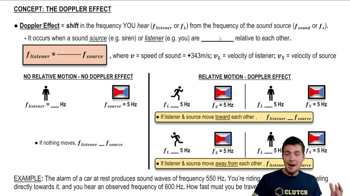
The Doppler Effect refers to the change in frequency or wavelength of a wave in relation to an observer moving relative to the source of the wave. In astronomy, it is commonly observed in the light from stars and galaxies, where a shift towards longer wavelengths (redshift) indicates that an object is moving away from the observer.
Recommended video:
Guided course
07:40
The Doppler Effect

Redshift

Redshift is a phenomenon where light from an object is shifted to longer wavelengths, typically observed in the light from galaxies moving away from Earth. It is quantified as the ratio of the change in frequency to the original frequency, and it provides critical information about the velocity of the object relative to the observer.

Velocity Calculation

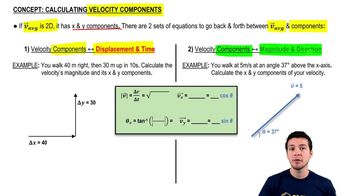
Velocity calculation in the context of the Doppler shift involves using the observed shift in frequency to determine how fast an object is moving away. The formula relates the observed frequency shift to the speed of light and the original frequency, allowing astronomers to estimate the recession velocity of distant galaxies.
Recommended video:
Guided course
05:53
Calculating Velocity Components
Related Practice
Textbook Question

An atomic clock is taken to the North Pole, while another stays at the Equator. How far will they be out of synchronization after 1.5 years has elapsed? [Hint: Use the binomial expansion, Appendix A–2.]

1018
views

Textbook Question

(III) (a) In reference frame S, a particle has momentum p=pxi\(\overrightarrow{\mathbf{p}\)}=p_{x}\(\mathbf{i}\) along the positive x axis. Show that in frame S’, which moves with speed v as in Fig. 36–12, the momentum has components

px=pxvE/c21v2/c2p_{x}^{\(\prime\)}=\(\frac{px-vE/c^2}{\sqrt{1-v^2/c^2}\)}

py=pyp_{y}^{\(\prime\)}=py

pz=pzp_{z}^{\(\prime\)}=pz

E=Epxv1v2/c2.E^{\(\prime\)}=\(\frac{E-p_{x}\)v}{\(\sqrt{1-v^2/c^2}\)}.

(These transformation equations hold, actually, for any direction of p\(\overrightarrow{\mathbf{p}\)}, as long as the motion of S' is along the x axis.) (b) Show that px, py, pz, E/c transform according to the Lorentz transformation in the same way as x, y, z, ct.

797
views
Textbook Question

Make a graph of the kinetic energy versus momentum for (a) a particle of nonzero mass, and (b) a particle with zero mass.

1054
views
Textbook Question

A spaceship moving toward Earth at 0.65c transmits radio signals at 95.0 MHz. At what frequency should Earth receivers be tuned?

1253
views
Textbook Question

An electron (m = 9.11 x 10⁻³¹ kg) is accelerated from rest to speed v by a conservative force. In this process, its potential energy decreases by 7.20 x 10⁻¹⁴ J . Determine the electron’s speed, v.

1110
views
Textbook Question

Show that the kinetic energy K of a particle of mass m is related to its momentum p by the equation p=K2+2Kmc2cp=\(\frac{\sqrt{K^2+2Kmc^2}\)}{c}.

1115
views