Ch. 21 - Conjugated Systems I: Stability and Addition Reactions
Mullins - Organic Chemistry: A Learner Centered Approach 1st Edition
Mullins1st EditionOrganic Chemistry: A Learner Centered ApproachISBN: 9780137566471Not the one you use?Change textbook
Chapter 20, Problem 7a

Hydroboration, an electrophilic addition reaction like those studied in Section 21.4, only gives 1,2-addition to buta-1,3-diene, regardless of temperature. Why?

Verified step by step guidance
1
Understand the concept of hydroboration: Hydroboration is an electrophilic addition reaction where borane (BH₃) or its derivatives react with alkenes to form organoboranes. This reaction typically proceeds via syn-addition, meaning both the boron atom and the hydrogen atom add to the same face of the double bond.
Analyze the structure of buta-1,3-diene: Buta-1,3-diene is a conjugated diene, meaning it has alternating double and single bonds (CH₂=CH-CH=CH₂). The conjugation allows for delocalization of π-electrons, which affects the reactivity of the molecule.
Consider the regioselectivity of hydroboration: Hydroboration typically adds to the less substituted carbon of the double bond due to steric and electronic factors. In the case of buta-1,3-diene, the reaction will target the terminal double bond (CH₂=CH-) because it is less sterically hindered compared to the internal double bond (-CH=CH₂).
Explain why only 1,2-addition occurs: The reaction proceeds through a concerted mechanism where the boron atom and hydrogen atom add simultaneously to the double bond. The conjugation in buta-1,3-diene stabilizes the intermediate formed during the addition, favoring the 1,2-addition product. The 1,4-addition product is not formed because the reaction does not involve a carbocation intermediate that would allow for rearrangement or resonance stabilization.
Discuss the role of temperature: Unlike other electrophilic addition reactions, hydroboration does not exhibit temperature-dependent selectivity in this case. The concerted mechanism and the inherent regioselectivity of hydroboration ensure that only the 1,2-addition product is formed, regardless of temperature.

Verified video answer for a similar problem:

This video solution was recommended by our tutors as helpful for the problem above.
Video duration:
5m
Was this helpful?

Key Concepts

Here are the essential concepts you must grasp in order to answer the question correctly.

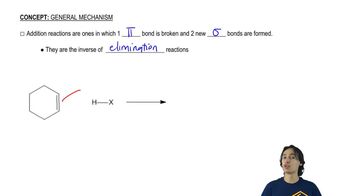
Electrophilic Addition Reactions

Electrophilic addition reactions involve the attack of an electrophile on a nucleophile, leading to the formation of a more saturated product. In the case of alkenes, the double bond acts as a nucleophile, reacting with electrophiles to form carbocations. This mechanism is crucial for understanding how reagents like borane add across double bonds, influencing the regioselectivity of the reaction.
Recommended video:
Guided course
05:39
Features of Addition Mechanisms.

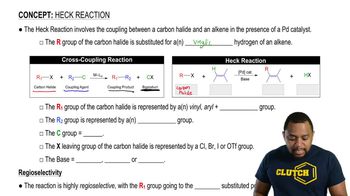
Regioselectivity

Regioselectivity refers to the preference of a chemical reaction to yield one structural isomer over others when multiple possibilities exist. In hydroboration, the reaction favors the formation of the more stable product through a specific pathway, leading to 1,2-addition in buta-1,3-diene. This concept is essential for predicting the outcome of reactions involving unsymmetrical alkenes.
Recommended video:
Guided course
05:09
Heck Reaction

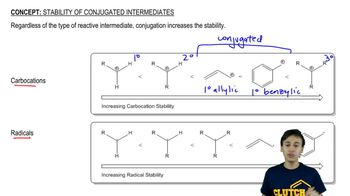
Stability of Intermediates

The stability of intermediates, such as carbocations formed during electrophilic addition, significantly influences the reaction pathway. In hydroboration, the formation of a less stable, but more reactive, intermediate leads to a consistent 1,2-addition product. Understanding how the stability of these intermediates affects the reaction mechanism is key to predicting the behavior of the reaction under various conditions.
Recommended video:
Guided course
04:31
Stability of Conjugated Intermediates