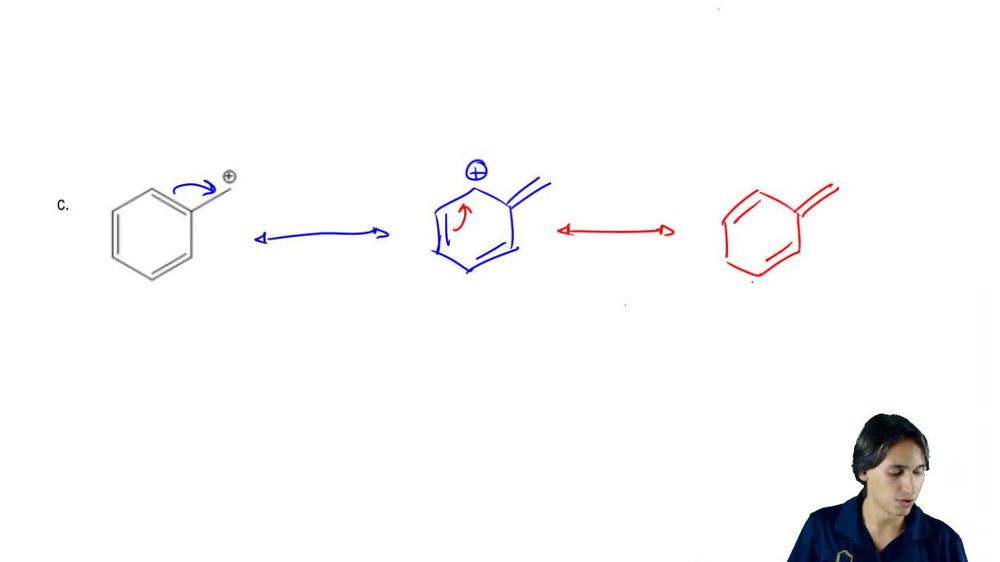
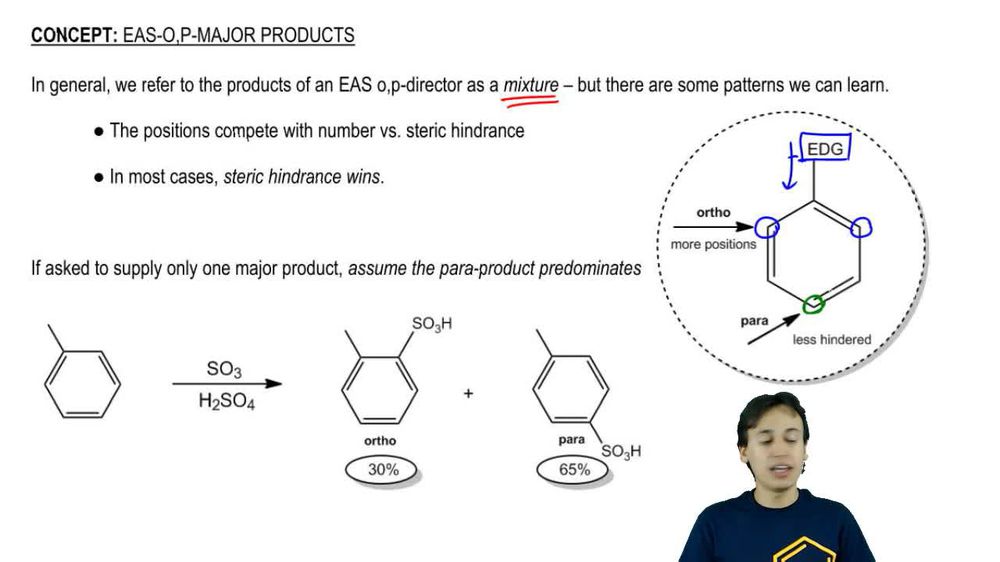
Using resonance contributors for the carbocation intermediate, explain why a phenyl group is an ortho–para director.
Verified step by step guidance
1
Identify the key concept: A phenyl group is an aromatic ring, and its ability to direct substituents to the ortho and para positions is due to resonance stabilization of the carbocation intermediate formed during electrophilic aromatic substitution.
Draw the resonance structures of the phenyl group with a substituent at the ortho position. Show how the delocalization of the positive charge through the aromatic ring stabilizes the carbocation intermediate. Use curved arrows to indicate electron movement.
Repeat the process for the para position. Draw the resonance structures and demonstrate how the positive charge is delocalized across the aromatic ring, providing similar stabilization as in the ortho position.
Compare the resonance structures for the ortho and para positions to those for the meta position. For the meta position, the positive charge cannot be delocalized onto the phenyl group, resulting in less stabilization of the carbocation intermediate.
Conclude that the phenyl group is an ortho–para director because the resonance contributors for the ortho and para positions allow for greater stabilization of the carbocation intermediate compared to the meta position.
Verified video answer for a similar problem:
This video solution was recommended by our tutors as helpful for the problem above
Video duration:
8m
Play a video:
0 Comments
Key Concepts
Here are the essential concepts you must grasp in order to answer the question correctly.
Carbocation Stability
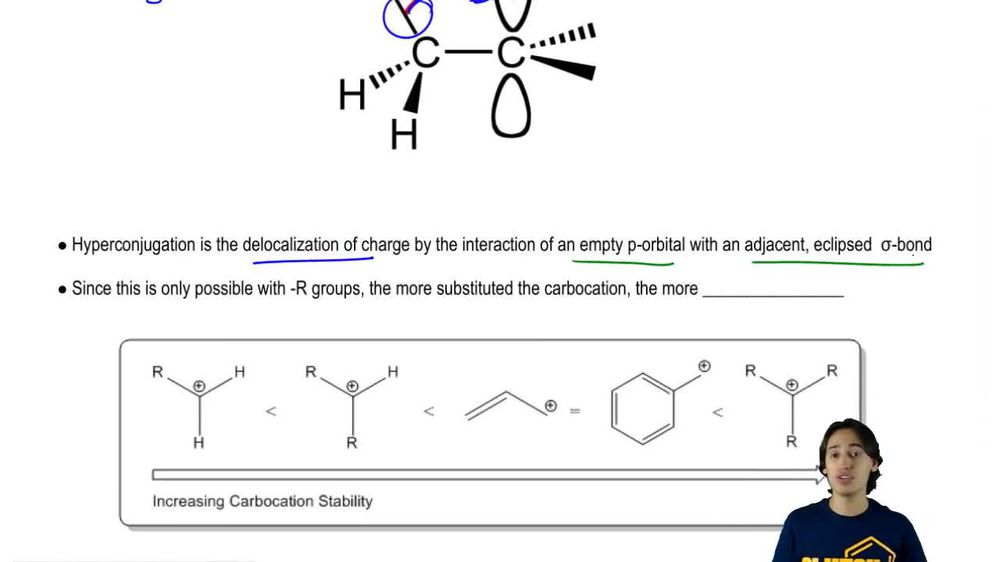
Carbocations are positively charged carbon species that are stabilized by adjacent electron-donating groups. The stability of a carbocation is crucial in determining the reactivity of electrophilic aromatic substitution reactions. A more stable carbocation intermediate leads to a more favorable reaction pathway, influencing the position of substitution on the aromatic ring.
Resonance contributors are different Lewis structures that represent the same molecule, illustrating how electrons are delocalized across the structure. In the case of a phenyl group, resonance allows the positive charge of the carbocation to be shared with the aromatic ring, enhancing stability. This delocalization is key to understanding how substituents influence the reactivity and orientation of electrophilic attacks.
Ortho-para directing effects refer to the tendency of certain substituents, like phenyl groups, to direct incoming electrophiles to the ortho and para positions on an aromatic ring during substitution reactions. This is due to the resonance stabilization of the carbocation intermediates formed at these positions, which are more stable than those formed at the meta position. Understanding this directing effect is essential for predicting the outcomes of electrophilic aromatic substitutions.

 8:25 minutes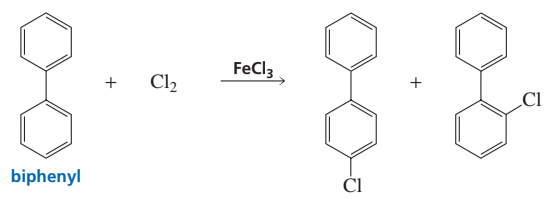
 Verified step by step guidance
 05:58
05:58