Ch. 11 - Properties and Synthesis of Alkyl Halides: Radical Reactions
Mullins - Organic Chemistry: A Learner Centered Approach 1st Edition
Mullins1st EditionOrganic Chemistry: A Learner Centered ApproachISBN: 9780137566471Not the one you use?Change textbook
Chapter 10, Problem 11.17

The most stable intermediate forms first. Explain this statement by showing a reaction coordinate diagram for the formation of a 3° carbocation over a 2° carbocation in the following alkene addition reaction.
Reaction coordinate diagram comparing the formation rates of 3° and 2° carbocations in an alkene addition reaction.

Verified step by step guidance
1
Step 1: Begin by understanding the concept of carbocation stability. A tertiary (3°) carbocation is more stable than a secondary (2°) carbocation due to hyperconjugation and inductive effects from surrounding alkyl groups. These effects help to delocalize the positive charge, making the intermediate more stable.
Step 2: Analyze the reaction mechanism for the addition of HCl to the alkenes shown in the image. The alkene undergoes electrophilic addition, where the π-electrons attack the proton (H⁺) from HCl, leading to the formation of a carbocation intermediate.
Step 3: Compare the reaction pathways for the two alkenes. In the first pathway (slower), the protonation of the alkene leads to the formation of a secondary (2°) carbocation. In the second pathway (faster), the protonation leads to the formation of a tertiary (3°) carbocation.
Step 4: Draw a reaction coordinate diagram to visualize the energy changes. The x-axis represents the reaction progress, and the y-axis represents the energy. The pathway leading to the tertiary carbocation will have a lower energy intermediate and transition state compared to the pathway leading to the secondary carbocation, making it faster.
Step 5: Conclude that the most stable intermediate forms first because the formation of a tertiary carbocation is energetically favorable. This explains why the reaction leading to the tertiary carbocation proceeds faster than the one leading to the secondary carbocation.

Verified video answer for a similar problem:

This video solution was recommended by our tutors as helpful for the problem above.
Video duration:
8m
Was this helpful?

Key Concepts

Here are the essential concepts you must grasp in order to answer the question correctly.

Carbocation Stability

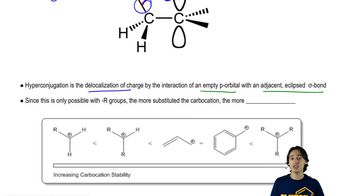
Carbocations are positively charged carbon species that can be classified based on their degree of substitution: primary (1°), secondary (2°), and tertiary (3°). Tertiary carbocations are the most stable due to hyperconjugation and the inductive effect from surrounding alkyl groups, which help to disperse the positive charge. Understanding this stability is crucial for predicting the pathway of reactions involving carbocation intermediates.
Recommended video:
Guided course
05:58
Determining Carbocation Stability

Reaction Coordinate Diagram

A reaction coordinate diagram visually represents the energy changes during a chemical reaction. It plots the energy of the system against the progress of the reaction, showing the transition states and intermediates. In the context of carbocation formation, the diagram illustrates the energy barriers associated with forming a 2° versus a 3° carbocation, highlighting that the formation of the more stable 3° carbocation has a lower activation energy and occurs more rapidly.
Recommended video:
Guided course
05:02
Coordination Complexes

Markovnikov's Rule

Markovnikov's Rule states that in the addition of HX to an alkene, the hydrogen atom will attach to the carbon with the greater number of hydrogen atoms, leading to the formation of the more stable carbocation. This principle helps predict the major product of alkene addition reactions, as the pathway leading to the more stable carbocation intermediate is favored, resulting in a faster reaction rate and higher yield of the product.
Recommended video:
Guided course
03:54
The 18 and 16 Electron Rule