Ch. 17 - Carbonyl Addition Reactions: Aldehydes and Ketones
Mullins - Organic Chemistry: A Learner Centered Approach 1st Edition
Mullins1st EditionOrganic Chemistry: A Learner Centered ApproachISBN: 9780137566471Not the one you use?Change textbook
Chapter 16, Problem 7d

Give a structure that corresponds to the name provided.
d. E-4-oxopent-2-enal

Verified step by step guidance
1
Identify the root name 'pent' which indicates a five-carbon chain as the backbone of the molecule.
Recognize the suffix '-enal' which signifies the presence of an aldehyde group (\(\text{CHO}\)) at the terminal carbon of the chain.
Note the prefix '4-oxo' which indicates a ketone group (\(\text{C=O}\)) located on the fourth carbon of the chain.
Understand the 'E' configuration, which means the highest priority groups on either side of the double bond at position 2 are on opposite sides.
Construct the structure by placing the aldehyde group at the first carbon, the ketone group at the fourth carbon, and ensuring the double bond between the second and third carbons has the 'E' configuration.

Verified video answer for a similar problem:

This video solution was recommended by our tutors as helpful for the problem above.
Video duration:
4m
Was this helpful?

Key Concepts

Here are the essential concepts you must grasp in order to answer the question correctly.

IUPAC Nomenclature

IUPAC nomenclature is a systematic method of naming organic chemical compounds as recommended by the International Union of Pure and Applied Chemistry. It provides a standardized way to name compounds based on their structure, ensuring that each name is unique and descriptive of the compound's molecular structure. Understanding IUPAC rules is essential for interpreting and constructing chemical names.
Recommended video:
Guided course
03:43
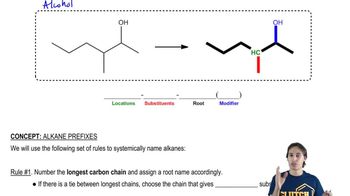
The different parts of an IUPAC name

E/Z Isomerism

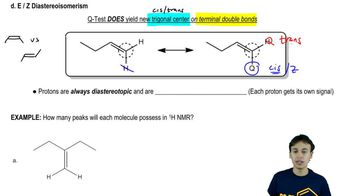
E/Z isomerism is a type of stereoisomerism found in alkenes, where the spatial arrangement of substituents around the double bond differs. 'E' (from the German 'entgegen') indicates that the highest priority groups on each carbon of the double bond are on opposite sides, while 'Z' ('zusammen') means they are on the same side. This concept is crucial for understanding the geometric configuration of alkenes.
Recommended video:
Guided course
03:48
E/Z Diastereoisomerism

Functional Groups

Functional groups are specific groups of atoms within molecules that are responsible for the characteristic chemical reactions of those molecules. In the name 'E-4-oxopent-2-enal', the 'oxo' group indicates a ketone, and 'enal' suggests the presence of both an alkene and an aldehyde. Recognizing these groups helps in predicting the reactivity and properties of the compound.
Recommended video:
Guided course
02:36
Identifying Functional Groups