Ch. 17 - Carbonyl Addition Reactions: Aldehydes and Ketones
Mullins - Organic Chemistry: A Learner Centered Approach 1st Edition
Mullins1st EditionOrganic Chemistry: A Learner Centered ApproachISBN: 9780137566471Not the one you use?Change textbook
Chapter 16, Problem 12a

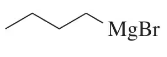
Classify the following nucleophiles as strong, weak, or intermediate. Would you expect each to add to a carbonyl directly or wait for a carbocation to form?
(a) Structural formula of an alkyl magnesium bromide compound, indicating a nucleophile for chemical reactions.

Verified step by step guidance
1
Step 1: Understand the concept of nucleophiles. Nucleophiles are species that donate a pair of electrons to form a new covalent bond. Their strength depends on factors such as charge, electronegativity, steric hindrance, and the solvent used.
Step 2: Analyze the nucleophile provided in the problem. If the nucleophile is negatively charged (e.g., OH⁻, CN⁻), it is typically a strong nucleophile. If it is neutral but has lone pairs (e.g., H2O, NH3), it is usually a weak nucleophile. Intermediate nucleophiles fall between these categories.
Step 3: Determine whether the nucleophile can directly attack a carbonyl group. Strong nucleophiles can add directly to the carbonyl carbon because they are sufficiently reactive to overcome the partial positive charge on the carbonyl carbon. Weak nucleophiles often require activation of the carbonyl group (e.g., protonation) or the formation of a carbocation intermediate.
Step 4: Consider the reaction mechanism. For strong nucleophiles, the reaction typically proceeds via a direct nucleophilic addition mechanism. For weak nucleophiles, the reaction may involve an acid-catalyzed pathway where the carbonyl group is protonated first, making it more electrophilic.
Step 5: Classify the nucleophile based on its properties and predict its behavior in the reaction. For example, if the nucleophile is OH⁻, it is a strong nucleophile and will likely add directly to the carbonyl. If the nucleophile is H2O, it is a weak nucleophile and may require a carbocation intermediate or activation of the carbonyl.

Verified video answer for a similar problem:

This video solution was recommended by our tutors as helpful for the problem above.
Video duration:
5m
Was this helpful?

Key Concepts

Here are the essential concepts you must grasp in order to answer the question correctly.

Nucleophilicity

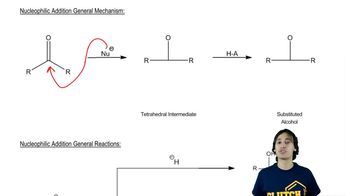
Nucleophilicity refers to the ability of a species to donate an electron pair to an electrophile, forming a chemical bond. Strong nucleophiles, such as alkoxides and amines, readily attack electrophiles like carbonyls, while weak nucleophiles, such as water and alcohols, are less reactive. Understanding the strength of nucleophiles is crucial for predicting their behavior in reactions involving carbonyl compounds.
Recommended video:
Guided course
08:27
Nucleophilic Addition

Carbonyl Compounds

Carbonyl compounds, characterized by a carbon atom double-bonded to an oxygen atom (C=O), are key functional groups in organic chemistry. They can undergo nucleophilic addition reactions, where nucleophiles attack the electrophilic carbon atom. The reactivity of carbonyls is influenced by the nature of the substituents attached to the carbonyl carbon, which can stabilize or destabilize the carbonyl group.
Recommended video:
Guided course
01:40
Defining meso compounds.

Carbocation Formation

Carbocations are positively charged carbon species that can form during certain organic reactions, often as intermediates. In some cases, weak nucleophiles may not directly attack a carbonyl but instead wait for a carbocation to form, which can then be attacked. Understanding the conditions under which carbocations form helps predict the pathways of nucleophilic reactions involving carbonyls.
Recommended video:
Guided course
07:21
Any Carbocation