
Ch. 16 - Aromatic Compounds
Wade - Organic Chemistry 9th Edition
Wade9th EditionOrganic ChemistryISBN: 9780135213728Not the one you use?Change textbook
Chapter 16, Problem 44a,b

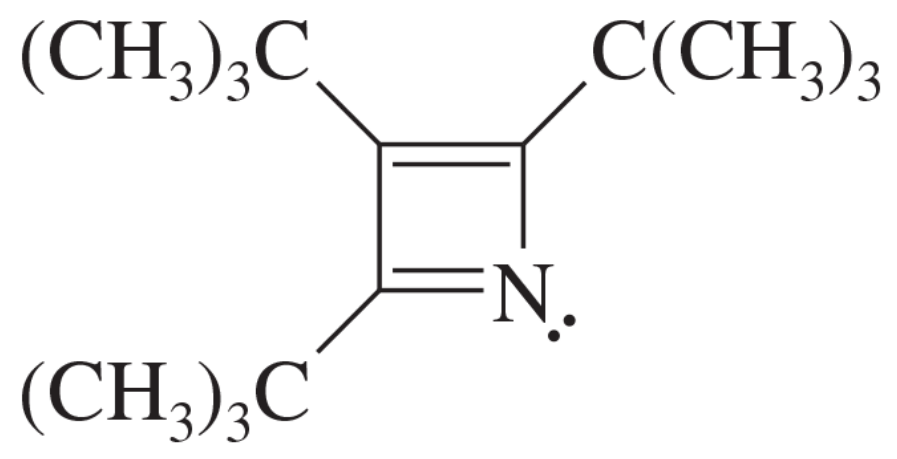
Consider the following compound, which has been synthesized and characterized:

a. Assuming this molecule is entirely conjugated, do you expect it to be aromatic, antiaromatic, or nonaromatic?
b. Why was this molecule synthesized with three tert-butyl substituents? Why not make the unsubstituted compound and study it instead?

Verified step by step guidance
1
Step 1: Analyze the structure of the molecule. The compound contains a nitrogen atom in a cyclic structure with alternating double bonds, indicating conjugation. The three tert-butyl groups ((CH3)3C) are bulky substituents attached to the ring.
Step 2: Determine aromaticity using Huckel's rule. Huckel's rule states that a molecule is aromatic if it is cyclic, planar, conjugated, and contains (4n + 2) π-electrons, where n is an integer. Count the π-electrons in the conjugated system, including the lone pair on nitrogen.
Step 3: Consider antiaromaticity. If the molecule is cyclic, planar, conjugated, and contains 4n π-electrons, it is antiaromatic. If the molecule fails both aromatic and antiaromatic criteria, it is nonaromatic.
Step 4: Address the role of tert-butyl substituents. The bulky tert-butyl groups are likely added to prevent dimerization or polymerization of the compound, which could occur due to the reactive nature of the nitrogen radical. They also help stabilize the molecule sterically and electronically.
Step 5: Explain why the unsubstituted compound was not studied. Without the tert-butyl groups, the molecule might be too unstable to isolate and study due to its high reactivity. The substituents provide steric hindrance, preventing unwanted side reactions and stabilizing the compound for experimental analysis.

Verified video answer for a similar problem:

This video solution was recommended by our tutors as helpful for the problem above.
Video duration:
2m
Was this helpful?

Key Concepts

Here are the essential concepts you must grasp in order to answer the question correctly.

Aromaticity

Aromatic compounds are cyclic, planar molecules with a ring of resonance bonds that follow Hückel's rule, which states that they must have 4n + 2 π electrons (where n is a non-negative integer). This unique electron configuration leads to increased stability and distinct chemical properties. To determine if a compound is aromatic, one must assess its cyclic structure, planarity, and electron count.
Recommended video:
Guided course
08:19
Intro to Aromaticity

Substituent Effects

Substituents on a benzene ring can significantly influence the compound's reactivity and stability. In this case, the presence of three tert-butyl groups provides steric hindrance, which can stabilize the molecule and prevent unwanted reactions. Additionally, these bulky groups can affect the electronic properties of the ring, making it more or less reactive depending on their nature.
Recommended video:
2:02
Directing Effects in Substituted Pyrroles, Furans, and Thiophenes Concept 1

Conjugation

Conjugation refers to the overlap of p-orbitals across adjacent double bonds or lone pairs, allowing for delocalization of π electrons. This delocalization can enhance stability and influence the reactivity of the compound. In the context of the given molecule, the presence of conjugated double bonds suggests that the compound may exhibit unique electronic properties, which are crucial for understanding its behavior in chemical reactions.
Recommended video:
Guided course
03:27
Conjugated states
Related Practice
Textbook Question

The ribonucleosides that make up ribonucleic acid (RNA) are composed of D-ribose (a sugar) and four heterocyclic “bases.” The general structure of a ribonucleoside is shown here.

The four heterocyclic bases are cytosine, uracil, guanine, and adenine. Cytosine and uracil are called pyrimidine bases because their structures resemble pyrimidine. Guanine and adenine are called purine bases because their structures resemble purine.

c. Do any of these bases have easily formed tautomers that are aromatic? (Consider moving a proton from nitrogen to a carbonyl group to form a phenolic derivative.)

697
views
Textbook Question

The ribonucleosides that make up ribonucleic acid (RNA) are composed of D-ribose (a sugar) and four heterocyclic “bases.” The general structure of a ribonucleoside is shown here.

The four heterocyclic bases are cytosine, uracil, guanine, and adenine. Cytosine and uracil are called pyrimidine bases because their structures resemble pyrimidine. Guanine and adenine are called purine bases because their structures resemble purine.

b. Predict which nitrogen atoms are basic.

620
views
Textbook Question

Hexahelicene seems a poor candidate for optical activity because all its carbon atoms are sp2 hybrids and presumably flat. Nevertheless, hexahelicene has been synthesized and separated into enantiomers. Its optical rotation is enormous: [α]D = 3700°. Explain why hexahelicene is optically active, and speculate as to why the rotation is so large.

747
views
Textbook Question

The ribonucleosides that make up ribonucleic acid (RNA) are composed of D-ribose (a sugar) and four heterocyclic “bases.” The general structure of a ribonucleoside is shown here.

The four heterocyclic bases are cytosine, uracil, guanine, and adenine. Cytosine and uracil are called pyrimidine bases because their structures resemble pyrimidine. Guanine and adenine are called purine bases because their structures resemble purine.

a. Determine which rings of these bases are aromatic.

914
views
Textbook Question

An unknown compound gives the following mass, IR, and NMR spectra. Propose a structure, and show how it is consistent with the spectra. Show the fragmentations that give the prominent peaks at m/z 127 and 155 in the mass spectrum.

<IMAGES>

3377
views
Textbook Question

Chlorophyll is the general name for a family of compounds present in algae and green plants. These molecules use the energy in sunlight to convert carbon dioxide and water into carbohydrates and other energy sources. At the heart of chlorophyll (shown below) is a large-ring magnesium complex called a chlorin. Circle each double bond in the large cyclic conjugated pi system that makes it aromatic. How many pi electrons are in this aromatic system?

996
views