Ch. 17 - Carbonyl Addition Reactions: Aldehydes and Ketones
Mullins - Organic Chemistry: A Learner Centered Approach 1st Edition
Mullins1st EditionOrganic Chemistry: A Learner Centered ApproachISBN: 9780137566471Not the one you use?Change textbook
Chapter 16, Problem 9a

Predict the reagents or reactant(s) necessary to complete the following syntheses.
(a) Chemical reaction diagram showing reagents DMSO and Et3N, leading to a product with hydroxyl and fluorine groups.

Verified step by step guidance
1
Identify the target molecule and the functional groups present. The target molecule is an aldehyde with a fluorine substituent and an isopropyl ether group.
Recognize the reagents used in the reaction: DMSO (dimethyl sulfoxide), oxalyl chloride (ClCOCOCl), and triethylamine (Et3N) in dichloromethane (CH2Cl2). This combination is characteristic of the Swern oxidation, which is used to oxidize alcohols to aldehydes or ketones.
Determine the starting material needed for the Swern oxidation. Since the product is an aldehyde, the starting material should be a primary alcohol with the same carbon skeleton as the product.
Analyze the structure of the product to deduce the structure of the starting alcohol. The starting alcohol should have the same carbon framework, with a hydroxyl group replacing the aldehyde group in the product.
Conclude that the starting material is a primary alcohol with the structure: (2R)-2-fluoro-3-methylbutan-1-ol. This alcohol will undergo Swern oxidation to form the desired aldehyde product.

Verified video answer for a similar problem:

This video solution was recommended by our tutors as helpful for the problem above.
Video duration:
3m
Was this helpful?

Key Concepts

Here are the essential concepts you must grasp in order to answer the question correctly.

Swern Oxidation

Swern oxidation is a chemical reaction used to convert primary and secondary alcohols to aldehydes and ketones, respectively. It involves the use of DMSO (dimethyl sulfoxide) activated by oxalyl chloride, followed by a base such as triethylamine (Et3N). This reaction is mild and avoids the use of heavy metals, making it suitable for sensitive substrates.
Recommended video:
Guided course
03:20
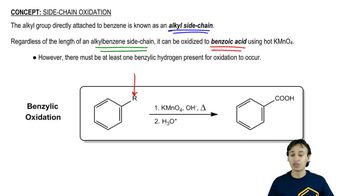
Benzylic Oxidation

Stereochemistry

Stereochemistry refers to the spatial arrangement of atoms in molecules and its impact on chemical reactions. In the given synthesis, the presence of a chiral center with a fluorine atom indicates the importance of stereochemical control. Understanding stereochemistry is crucial for predicting the configuration of products in reactions involving chiral centers.
Recommended video:
1:38
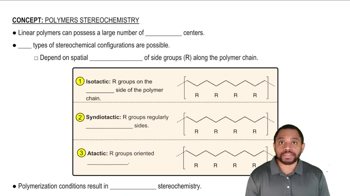
Polymer Stereochemistry Concept 1

Reagent Selection

Reagent selection is critical in organic synthesis to achieve desired transformations. The choice of DMSO and oxalyl chloride suggests a Swern oxidation, while Et3N acts as a base to neutralize acidic byproducts. Selecting appropriate reagents ensures the reaction proceeds efficiently and yields the intended product with the correct functional groups.
Recommended video: