Ch. 11 - Properties and Synthesis of Alkyl Halides: Radical Reactions
Mullins - Organic Chemistry: A Learner Centered Approach 1st Edition
Mullins1st EditionOrganic Chemistry: A Learner Centered ApproachISBN: 9780137566471Not the one you use?Change textbook
Chapter 10, Problem 53

One danger associated with storing ether solvents is their tendency to form explosive peroxides when exposed to oxygen. Suggest a mechanism by which the hydroperoxide might form. You can assume the presence of X• to start the reaction.
Chemical reaction showing ether forming hydroperoxide with O2.

Verified step by step guidance
1
Start by considering the initiation step where the radical X• abstracts a hydrogen atom from the ether molecule, generating an ether radical. This can be represented as: X+RORROR+H
Next, consider the propagation step where the ether radical reacts with molecular oxygen (O2). The ether radical can add to the oxygen molecule, forming a peroxy radical. This step can be represented as: ROR+O2ROOR
In the next step, the peroxy radical can abstract a hydrogen atom from another ether molecule, forming the hydroperoxide and regenerating the ether radical. This can be represented as: ROOR+RORROOH+ROR
Consider the termination step where two radicals combine to form a stable product, thus ending the chain reaction. For example, two ether radicals can combine to form a stable ether molecule: ROR+RORROR+ROR
Finally, review the overall mechanism and ensure that each step logically follows from the previous one, maintaining the radical chain process that leads to the formation of hydroperoxides. Consider the implications of radical stability and the presence of oxygen in the environment.

Verified video answer for a similar problem:

This video solution was recommended by our tutors as helpful for the problem above.
Video duration:
7m
Was this helpful?

Key Concepts

Here are the essential concepts you must grasp in order to answer the question correctly.

Radical Initiation

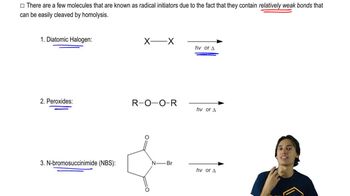
Radical initiation is the process by which a radical species is generated, often through the homolytic cleavage of a bond. In this context, the presence of X• suggests that a radical initiator is present, which can abstract a hydrogen atom from the ether, forming a carbon-centered radical. This step is crucial as it sets the stage for subsequent radical reactions.
Recommended video:
Guided course
03:49
What are Radical Initiators?

Radical Propagation

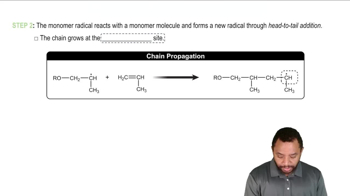
Radical propagation involves the reaction of radicals with stable molecules to form new radicals, perpetuating the chain reaction. In the formation of hydroperoxides, the carbon-centered radical reacts with molecular oxygen (O2), a diradical, to form a peroxy radical. This peroxy radical can further react with another ether molecule, abstracting a hydrogen atom to form a hydroperoxide and regenerate the carbon-centered radical.
Recommended video:
1:01
Radical Polymerization Concept 3

Radical Termination

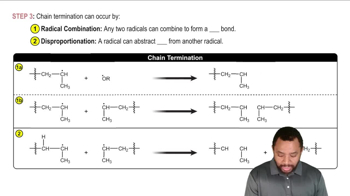
Radical termination occurs when two radical species combine to form a stable, non-radical product, effectively ending the chain reaction. In the context of ether peroxide formation, termination can occur when two radicals, such as peroxy radicals, combine to form a stable peroxide compound. This step is essential to prevent the indefinite propagation of radicals, which can lead to explosive peroxide accumulation.
Recommended video:
1:30
Radical Polymerization Concept 4