Ch. 9 - Alkenes II: Oxidation and Reduction
Mullins - Organic Chemistry: A Learner Centered Approach 1st Edition
Mullins1st EditionOrganic Chemistry: A Learner Centered ApproachISBN: 9780137566471Not the one you use?Change textbook
Chapter 8, Problem 45d(iii)

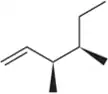
Predict the product(s) that would result when the alkenes are allowed to react under the following conditions: (iii) Br2, H2O
(d) Chemical structure of an alkene with two double bonds, indicating potential sites for halogenation reactions.

Verified step by step guidance
1
Identify the type of reaction: The reaction involves an alkene reacting with bromine (Br₂) in the presence of water (H₂O). This is an example of a halohydrin formation reaction, where the alkene undergoes an electrophilic addition reaction.
Understand the mechanism: The reaction proceeds via the formation of a bromonium ion intermediate. The π-electrons of the alkene attack a bromine molecule (Br₂), leading to the formation of a three-membered bromonium ion.
Determine the nucleophile: In the presence of water, the water molecule acts as the nucleophile. It attacks the more substituted carbon of the bromonium ion due to the partial positive charge being more stabilized at that position (Markovnikov's rule).
Add the nucleophile: The water molecule opens the bromonium ion ring by attacking the more substituted carbon, leading to the formation of a halohydrin. The hydroxyl group (-OH) attaches to the more substituted carbon, while the bromine atom attaches to the less substituted carbon.
Draw the product: The final product is a halohydrin, where the -OH group and the -Br group are added across the double bond in an anti-addition manner (opposite sides of the former double bond). Ensure stereochemistry is considered if the starting alkene is asymmetric.

Verified video answer for a similar problem:

This video solution was recommended by our tutors as helpful for the problem above.
Video duration:
4m
Was this helpful?

Key Concepts

Here are the essential concepts you must grasp in order to answer the question correctly.

Electrophilic Addition

Electrophilic addition is a fundamental reaction mechanism in organic chemistry where an electrophile reacts with a nucleophile, typically involving alkenes. In the case of alkenes reacting with Br₂, the double bond acts as a nucleophile, attacking the electrophilic bromine molecule, leading to the formation of a cyclic bromonium ion intermediate.
Recommended video:
Guided course
09:23
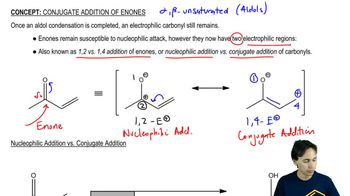
1,2 vs 1,4 Addition

Bromohydrin Formation

Bromohydrin formation occurs when an alkene reacts with bromine in the presence of water. The bromonium ion intermediate is attacked by water, resulting in the addition of a bromine atom and a hydroxyl group across the double bond, yielding a bromohydrin product. This reaction is stereospecific and can lead to different stereoisomers depending on the alkene's configuration.
Recommended video:
Guided course
02:26
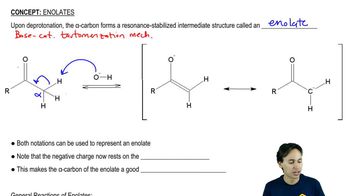
Formation of Enolates

Regioselectivity

Regioselectivity refers to the preference of a chemical reaction to yield one structural isomer over others when multiple products are possible. In the reaction of alkenes with Br₂ and H₂O, the regioselectivity is influenced by the stability of the carbocation intermediates formed during the reaction, which can lead to Markovnikov or anti-Markovnikov products depending on the substituents on the alkene.
Recommended video:
Guided course
05:09
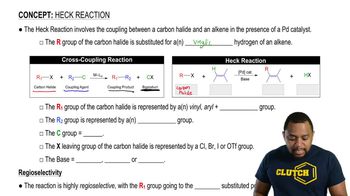
Heck Reaction