Ch. 12 - Radicals
Bruice - Organic Chemistry 8th Edition
Bruice8th EditionOrganic ChemistryISBN: 9780135213711Not the one you use?Change textbook
Chapter 13, Problem 40c

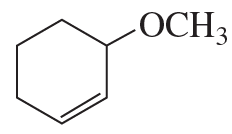
Starting with cyclohexane, how could the following compounds be prepared?
c. Cyclohexane structure with a methoxy group (OCH3) attached, illustrating a radical reaction concept.

Verified step by step guidance
1
Step 1: Begin with cyclohexane as the starting material. To introduce a double bond into the cyclohexane ring, perform a dehydrogenation reaction. This can be achieved using a catalyst such as platinum, palladium, or nickel under high temperature to convert cyclohexane into cyclohexene.
Step 2: To introduce the methoxy group (-OCH3) at the allylic position, perform an allylic bromination on cyclohexene. Use N-bromosuccinimide (NBS) in the presence of light or heat to selectively brominate the allylic position, forming allyl bromocyclohexene.
Step 3: Replace the bromine atom with a methoxy group (-OCH3) through a nucleophilic substitution reaction. React allyl bromocyclohexene with sodium methoxide (NaOCH3) in methanol to achieve this substitution.
Step 4: Verify the structure of the product to ensure the methoxy group is correctly positioned at the allylic carbon and the double bond remains intact in the cyclohexene ring.
Step 5: Purify the final product using techniques such as distillation or chromatography to isolate the desired compound.

Verified video answer for a similar problem:

This video solution was recommended by our tutors as helpful for the problem above.
Video duration:
6m
Was this helpful?

Key Concepts

Here are the essential concepts you must grasp in order to answer the question correctly.

Radical Reactions

Radical reactions involve the formation and reaction of free radicals, which are highly reactive species with unpaired electrons. These reactions often proceed through initiation, propagation, and termination steps. Understanding how radicals can be generated from cyclohexane, such as through halogenation or thermal decomposition, is crucial for synthesizing more complex structures.
Recommended video:
Guided course
03:49
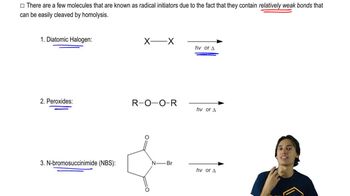
What are Radical Initiators?

Cyclohexane Derivatives

Cyclohexane can be transformed into various derivatives through functionalization reactions. This includes the introduction of functional groups like alcohols, halides, or alkenes. Recognizing how to manipulate the cyclohexane structure to create derivatives is essential for preparing the target compound shown in the image.
Recommended video:
Guided course
02:49
Ammonia Derivatives

Electrophilic Aromatic Substitution

Electrophilic aromatic substitution (EAS) is a key reaction mechanism in organic chemistry where an electrophile replaces a hydrogen atom on an aromatic ring. This process is vital for modifying aromatic compounds derived from cyclohexane. Understanding the conditions and reagents that facilitate EAS will help in synthesizing the desired compound from cyclohexane derivatives.
Recommended video: