Ch. 14 - Ethers, Epoxides, and Thioethers
Wade - Organic Chemistry 9th Edition
Wade9th EditionOrganic ChemistryISBN: 9780135213728Not the one you use?Change textbook
Chapter 14, Problem 2

Aluminum trichloride (AlCl3) dissolves in ether with the evolution of a large amount of heat. (In fact, this reaction can become rather violent if it gets too warm.) Show the structure of the resulting aluminum chloride etherate complex.

Verified step by step guidance
1
Understand the nature of aluminum trichloride (AlCl₃): It is a Lewis acid due to the electron deficiency of aluminum, which has an incomplete octet.
Recognize the role of ether in the reaction: Ether acts as a Lewis base because the oxygen atom in ether has lone pairs of electrons that can be donated to aluminum.
Visualize the interaction: The aluminum atom in AlCl₃ accepts electron pairs from the oxygen atom in ether, forming a coordinate covalent bond. This results in the formation of an aluminum chloride etherate complex.
Draw the structure of the complex: Represent the aluminum atom bonded to three chlorine atoms (AlCl₃) and also bonded to the oxygen atom of the ether molecule via a coordinate covalent bond. Use arrows to indicate the donation of electron pairs from oxygen to aluminum.
Consider the stoichiometry: Depending on the amount of ether present, multiple ether molecules may coordinate with a single AlCl₃ molecule, forming a complex such as AlCl₃·(ether)n, where n represents the number of ether molecules involved.

Verified video answer for a similar problem:

This video solution was recommended by our tutors as helpful for the problem above.
Video duration:
3m
Was this helpful?

Key Concepts

Here are the essential concepts you must grasp in order to answer the question correctly.

Lewis Acids and Bases

Lewis acids are substances that can accept an electron pair, while Lewis bases are those that can donate an electron pair. In the context of aluminum trichloride, it acts as a Lewis acid due to its electron-deficient aluminum center, which can coordinate with electron-rich species like ethers. Understanding this interaction is crucial for grasping how aluminum chloride forms complexes in solution.
Recommended video:
Guided course
02:49
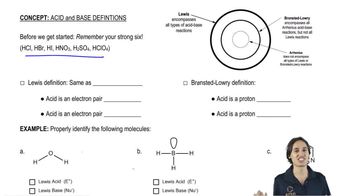
The Lewis definition of acids and bases.

Coordination Complexes

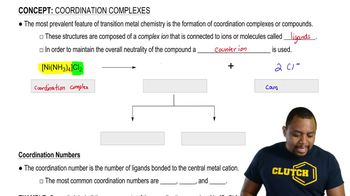
Coordination complexes consist of a central metal atom bonded to surrounding molecules or ions, known as ligands. In the case of aluminum chloride etherate, the ether acts as a ligand that coordinates to the aluminum ion, stabilizing the complex. Recognizing the geometry and bonding in these complexes is essential for visualizing the structure formed during the reaction.
Recommended video:
Guided course
05:02
Coordination Complexes

Thermodynamics of Dissolution

The dissolution of substances in solvents involves thermodynamic principles, including enthalpy and entropy changes. The exothermic nature of aluminum trichloride dissolving in ether indicates that the process releases heat, which can lead to increased temperature and potentially violent reactions. Understanding these thermodynamic concepts helps predict the behavior of the system during the formation of the aluminum chloride etherate complex.
Recommended video:
Guided course
08:51
Kinetic vs. Thermodynamic Control