Ch. 4 - Isomers: The Arrangement of Atoms in Space
Bruice - Organic Chemistry 8th Edition
Bruice8th EditionOrganic ChemistryISBN: 9780135213711Not the one you use?Change textbook
Chapter 5, Problem 13e-h

Which of the following objects are chiral?
e. a wheelbarrow
f. a remote control device
g. a nail
h. screw

Verified step by step guidance
1
Step 1: Understand the concept of chirality. An object is chiral if it cannot be superimposed on its mirror image. This property is often associated with asymmetry.
Step 2: Analyze the wheelbarrow. A wheelbarrow typically has a symmetrical design, meaning its mirror image can be superimposed on the original. Therefore, it is not chiral.
Step 3: Examine the remote control device. Most remote controls are designed symmetrically for ergonomic purposes, making them superimposable on their mirror image. Thus, they are not chiral.
Step 4: Consider the nail. A standard nail is symmetrical along its axis, meaning its mirror image can be superimposed on the original. Hence, it is not chiral.
Step 5: Evaluate the screw. A screw often has a helical thread, which introduces asymmetry. Its mirror image cannot be superimposed on the original, making it chiral.

Verified video answer for a similar problem:

This video solution was recommended by our tutors as helpful for the problem above.
Video duration:
2m
Was this helpful?

Key Concepts

Here are the essential concepts you must grasp in order to answer the question correctly.

Chirality

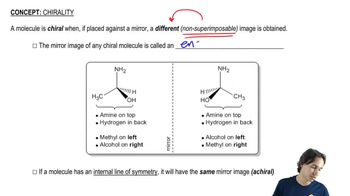
Chirality is a property of a molecule that makes it non-superimposable on its mirror image, much like left and right hands. A chiral object typically has an asymmetric carbon atom, which is bonded to four different substituents. This concept is crucial in organic chemistry as it affects the behavior of molecules in biological systems and their interactions with other chiral molecules.
Recommended video:
Guided course
05:10
What is chirality?

Symmetry

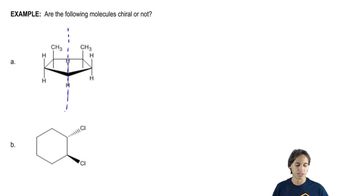
Symmetry in chemistry refers to the balanced and proportionate arrangement of parts in a molecule or object. An object is considered symmetric if it can be divided into two identical halves. Understanding symmetry helps in identifying chiral objects, as chiral items lack a plane of symmetry, while achiral items possess one.
Recommended video:
Guided course
00:25
Determining Chirality with Plane of Symmetry

Examples of Chiral and Achiral Objects

In organic chemistry, examples of chiral objects include molecules like amino acids and certain drugs, while achiral objects include symmetrical items like a wheelbarrow or a nail. Recognizing these examples aids in distinguishing between chiral and achiral substances, which is essential for understanding their chemical behavior and interactions.
Recommended video:
Guided course
05:10
What is chirality?