Ch. 8 - Delocalized Electrons: Their Effect on Stability, pKa, and the Products of a Reaction • Aromaticity and Electronic Effects: An Introduction to the Reactions of Benzene
Bruice - Organic Chemistry 8th Edition
Bruice8th EditionOrganic ChemistryISBN: 9780135213711Not the one you use?Change textbook
Chapter 9, Problem 50b

Which compound in each set is aromatic? Explain your choice.
b. Structures of cycloheptatriene, cycloheptatrienyl cation, and cycloheptatrienyl anion with labels.

Verified step by step guidance
1
Step 1: Recall the criteria for aromaticity. A compound is aromatic if it satisfies the following conditions: (1) It is cyclic, (2) It is planar, (3) It has a conjugated π-electron system, and (4) It follows Hückel's rule, which states that the molecule must have (4n + 2) π-electrons, where n is a non-negative integer.
Step 2: Analyze cycloheptatriene. Cycloheptatriene is cyclic and has conjugated π-electrons, but it does not satisfy Hückel's rule because it has 6 π-electrons, which corresponds to 4n (not 4n + 2). Additionally, the molecule is not fully planar due to the sp3-hybridized carbon atom in the ring.
Step 3: Analyze cycloheptatrienyl cation. The cation is cyclic, planar, and has a conjugated π-electron system. It contains 6 π-electrons, which satisfies Hückel's rule (4n + 2, where n = 1). Therefore, the cycloheptatrienyl cation is aromatic.
Step 4: Analyze cycloheptatrienyl anion. The anion is cyclic and has a conjugated π-electron system, but it contains 8 π-electrons, which does not satisfy Hückel's rule (4n + 2). Thus, the cycloheptatrienyl anion is not aromatic.
Step 5: Conclude that among the three compounds, the cycloheptatrienyl cation is aromatic because it satisfies all the criteria for aromaticity, including Hückel's rule.

Verified video answer for a similar problem:

This video solution was recommended by our tutors as helpful for the problem above.
Video duration:
3m
Was this helpful?

Key Concepts

Here are the essential concepts you must grasp in order to answer the question correctly.

Aromaticity

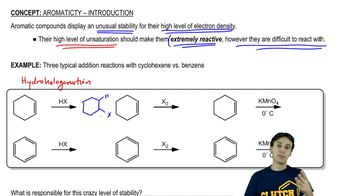
Aromaticity is a property of cyclic compounds that exhibit enhanced stability due to resonance and follow Hückel's rule, which states that a compound must have (4n + 2) π electrons, where n is a non-negative integer. Aromatic compounds are typically planar, fully conjugated, and have a continuous ring of p-orbitals. This unique stability is what distinguishes aromatic compounds from non-aromatic and anti-aromatic compounds.
Recommended video:
Guided course
08:19
Intro to Aromaticity

Cycloheptatriene

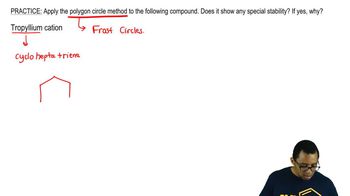
Cycloheptatriene is a seven-membered cyclic hydrocarbon with three double bonds. It is not aromatic because it does not meet the criteria for aromaticity; specifically, it has 6 π electrons, which does not satisfy Hückel's rule. Additionally, cycloheptatriene is not planar and lacks full conjugation, further disqualifying it from being aromatic.
Recommended video:
Guided course
02:56
Inscribed Polygon Method

Cycloheptatrienyl Cation and Anion

The cycloheptatrienyl cation and anion are charged species derived from cycloheptatriene. The cation has a positive charge and contains 6 π electrons, making it aromatic as it satisfies Hückel's rule. Conversely, the anion has 8 π electrons, which makes it anti-aromatic and thus unstable. Understanding the electronic structure of these ions is crucial for determining their aromaticity.
Recommended video:
1:06
Anionic Polymerization Concept 4