Ch. 2 - General Chemistry Translated: Finding the Electrons
Mullins - Organic Chemistry: A Learner Centered Approach 1st Edition
Mullins1st EditionOrganic Chemistry: A Learner Centered ApproachISBN: 9780137566471Not the one you use?Change textbook
Chapter 1, Problem 64f

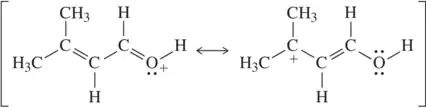
Two resonance structures are shown for each molecule. Use the arrow-pushing formalism to represent the electron flow from the structure on the left to the one on the right.
(f) Two resonance structures of a molecule with arrow-pushing formalism indicating electron flow between them.

Verified step by step guidance
1
Step 1: Identify the resonance structures provided in the problem. Resonance structures differ in the placement of electrons, specifically π-electrons and lone pairs, while the arrangement of atoms remains the same.
Step 2: Locate the regions in the molecule where electron movement occurs. Typically, this involves π-bonds, lone pairs, or formal charges. Look for areas where electrons can delocalize to stabilize the molecule.
Step 3: Use curved arrows to represent the movement of electrons. A curved arrow starts at the source of electrons (a lone pair or a bond) and points to where the electrons are moving. Ensure the arrows follow the rules of electron flow: electrons move from areas of high electron density to areas of lower electron density.
Step 4: Verify that the resulting resonance structure adheres to the rules of resonance. The connectivity of atoms must remain unchanged, and the total number of electrons must be conserved. Ensure that formal charges are correctly assigned in the new structure.
Step 5: Confirm that the resonance structures are valid and contribute to the resonance hybrid. Resonance structures should differ only in the placement of electrons, not the arrangement of atoms, and should follow the octet rule where applicable.

Verified video answer for a similar problem:

This video solution was recommended by our tutors as helpful for the problem above.
Was this helpful?

Key Concepts

Here are the essential concepts you must grasp in order to answer the question correctly.

Resonance Structures

Resonance structures are different ways of drawing the same molecule that illustrate the delocalization of electrons. They are used to represent molecules that cannot be accurately depicted by a single Lewis structure. Each resonance structure contributes to the overall hybrid structure, which is a more accurate representation of the molecule's electron distribution.
Recommended video:
Guided course
03:04
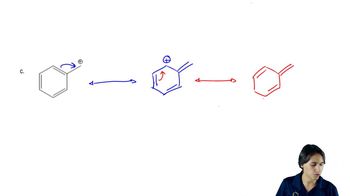
Drawing Resonance Structures

Arrow-Pushing Formalism

Arrow-pushing formalism is a method used in organic chemistry to depict the movement of electrons during chemical reactions. Arrows indicate the direction of electron flow, with a double-headed arrow showing the movement of a pair of electrons and a single-headed arrow indicating the movement of a single electron. This technique helps visualize how bonds are formed and broken in chemical transformations.
Recommended video:
Guided course
01:34
Calculating formal and net charge.

Electron Delocalization

Electron delocalization refers to the phenomenon where electrons are spread over several atoms rather than being localized between two atoms. This occurs in resonance structures, where the electrons can occupy multiple positions, leading to increased stability of the molecule. Delocalization is a key factor in understanding the reactivity and properties of organic compounds.
Recommended video:
Guided course
03:54
The 18 and 16 Electron Rule