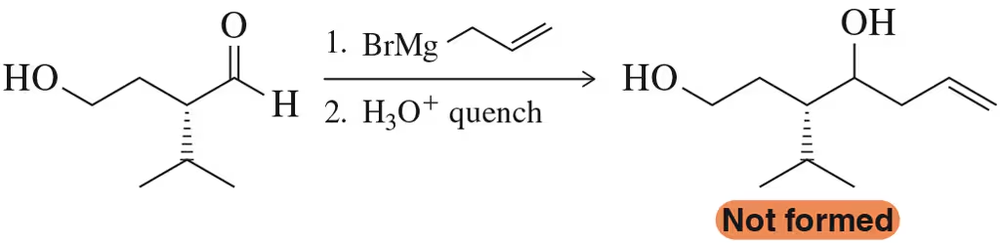
A chemist failed to generate the diol using the reaction shown here. (a) Suggest a reason why this reaction did not work as written. (b) How could the reaction conditions be modified to allow formation of the diol? [It may require more than one step.]
Verified step by step guidance
1
Analyze the reaction: The starting material is a β-hydroxy ketone, and the reaction involves a Grignard reagent (BrMgCH=CH2) followed by an acidic quench. The desired product is a diol, but the reaction fails to produce it.
Identify the issue: Grignard reagents are highly reactive nucleophiles and bases. The hydroxyl group (-OH) in the starting material is acidic and can react with the Grignard reagent, leading to protonation of the Grignard reagent and deactivation of its nucleophilicity. This prevents the Grignard reagent from attacking the carbonyl group.
Propose a solution: To prevent the Grignard reagent from reacting with the hydroxyl group, the hydroxyl group must be protected. A common protecting group for alcohols is a silyl ether, such as a trimethylsilyl (TMS) group. The hydroxyl group can be converted to a TMS ether using a reagent like TMSCl and a base (e.g., Et3N).
Modify the reaction: After protecting the hydroxyl group, the Grignard reagent can be added to react with the carbonyl group, forming the desired intermediate. After the reaction is complete, the protecting group can be removed using an acidic or fluoride-based deprotection step (e.g., TBAF) to regenerate the hydroxyl group.
Summarize the steps: (1) Protect the hydroxyl group using a silyl ether. (2) Perform the Grignard reaction with the protected compound. (3) Quench the reaction with H3O+ to form the alcohol. (4) Deprotect the silyl ether to regenerate the hydroxyl group, yielding the desired diol.
Verified video answer for a similar problem:
This video solution was recommended by our tutors as helpful for the problem above
Play a video:
0 Comments
Key Concepts
Here are the essential concepts you must grasp in order to answer the question correctly.
Reaction Mechanisms
Understanding reaction mechanisms is crucial in organic chemistry as it explains the step-by-step process by which reactants transform into products. This includes identifying intermediates, transition states, and the role of catalysts. A failure to generate the diol may stem from an incomplete or incorrect mechanism that does not favor the formation of the desired product.
Functional group transformations involve the conversion of one functional group into another through chemical reactions. In the context of diol formation, recognizing the starting materials and the necessary transformations to introduce hydroxyl groups is essential. Modifying reaction conditions may involve using reagents that facilitate these transformations effectively.
Reaction conditions, including temperature, pressure, solvent, and the presence of catalysts, significantly influence the outcome of chemical reactions. Adjusting these conditions can enhance the yield of the desired product, such as a diol. For instance, using a different solvent or temperature may stabilize intermediates or transition states, leading to successful diol formation.

 Verified step by step guidance
 02:16
02:16