Ch. 20 - The Organic Chemistry of Carbohydrates
Bruice - Organic Chemistry 8th Edition
Bruice8th EditionOrganic ChemistryISBN: 9780135213711Not the one you use?Change textbook
Chapter 21, Problem 31b

What is the main structural difference between b. amylose and amylopectin?

Verified step by step guidance
1
Amylose and amylopectin are both polysaccharides composed of glucose monomers, but they differ in their structure and branching.
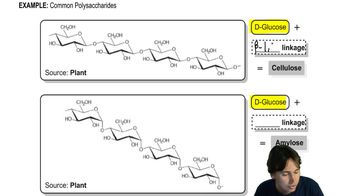
Amylose is a linear polymer of glucose units connected by α(1→4) glycosidic bonds, meaning the glucose molecules are linked in a straight chain.
Amylopectin, on the other hand, is a branched polymer. It contains α(1→4) glycosidic bonds in the linear sections and α(1→6) glycosidic bonds at the branch points.
The branching in amylopectin occurs approximately every 24–30 glucose units, giving it a more complex and compact structure compared to amylose.
This structural difference affects their physical properties: amylose tends to form helical structures and is less soluble in water, while amylopectin is more soluble and has a higher molecular weight due to its branching.

Verified video answer for a similar problem:

This video solution was recommended by our tutors as helpful for the problem above.
Video duration:
6m
Was this helpful?

Key Concepts

Here are the essential concepts you must grasp in order to answer the question correctly.

Polysaccharide Structure

Polysaccharides are large carbohydrate molecules composed of long chains of monosaccharide units. The structure of polysaccharides can vary significantly, influencing their properties and functions. Amylose and amylopectin are both polysaccharides made of glucose units, but they differ in their arrangement and bonding, which affects their digestibility and role in energy storage.
Recommended video:
Guided course
11:53
Polysaccharide

Amylose

Amylose is a linear polymer of glucose units connected by α(1→4) glycosidic bonds. This structure allows amylose to form a helical shape, which is less soluble in water compared to its counterpart. Amylose typically constitutes about 20-30% of starch and is digested more slowly, providing a gradual release of glucose.
Recommended video:
Guided course
11:53
Polysaccharide

Amylopectin

Amylopectin is a branched polymer of glucose, consisting of α(1→4) glycosidic bonds along with α(1→6) bonds at the branching points. This branching structure makes amylopectin more soluble in water and allows for quicker digestion and energy release. It accounts for about 70-80% of starch, making it a crucial energy source in many plants.
Recommended video:
Guided course
11:53
Polysaccharide