Ch.1 - Structure and Bonding
Wade - Organic Chemistry 9th Edition
Wade9th EditionOrganic ChemistryISBN: 9780135213728Not the one you use?Change textbook
Chapter 1, Problem 15b

Make a model of propane (C3H8), and draw this model using dashed lines and wedges to represent bonds going back and coming forward.

Verified step by step guidance
1
Start by identifying the central carbon atom in propane (C3H8). Propane consists of three carbon atoms in a chain. The central carbon atom will be bonded to the other two carbon atoms.
Draw the central carbon atom and connect it to the two terminal carbon atoms using solid lines to represent the sigma bonds between them. This forms the backbone of the propane molecule.
Add hydrogen atoms to each carbon atom. Each terminal carbon atom (the first and third carbon) will have three hydrogen atoms attached, while the central carbon atom will have two hydrogen atoms attached. This ensures that each carbon atom forms four bonds, satisfying the tetravalency of carbon.
Use dashed lines to represent bonds that are going behind the plane of the paper and wedges to represent bonds that are coming out of the plane. For example, on the central carbon, you can use a wedge to show one hydrogen coming out towards you and a dashed line for one going back.
Ensure that the spatial arrangement of the atoms reflects the tetrahedral geometry around each carbon atom, which is typical for alkanes like propane. This involves arranging the hydrogen atoms around each carbon atom in a way that maximizes the distance between them, minimizing electron pair repulsion.

Verified video answer for a similar problem:

This video solution was recommended by our tutors as helpful for the problem above.
Video duration:
4m
Was this helpful?

Key Concepts

Here are the essential concepts you must grasp in order to answer the question correctly.

Molecular Geometry

Molecular geometry refers to the three-dimensional arrangement of atoms within a molecule. For propane (C3H8), understanding its geometry is crucial as it determines how atoms are spatially oriented, affecting how bonds are represented using dashed lines and wedges to indicate depth and perspective.
Recommended video:
Guided course
07:44
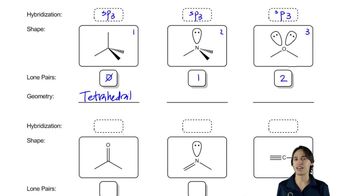
Molecular Geometry Explained.

Bond Representation

In organic chemistry, bonds are often represented using dashed lines and wedges to convey their spatial orientation. Dashed lines indicate bonds receding into the plane, while wedges show bonds projecting out of the plane. This representation helps visualize the 3D structure of molecules like propane.
Recommended video:
Guided course
06:00
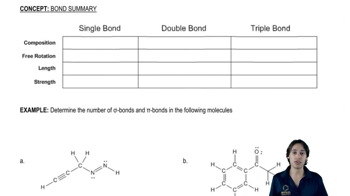
Single bonds, double bonds, and triple bonds.

Alkane Structure

Propane is an alkane, a type of hydrocarbon characterized by single bonds between carbon atoms. Understanding the basic structure of alkanes, which involves a chain of carbon atoms surrounded by hydrogen atoms, is essential for constructing and visualizing the molecular model of propane.
Recommended video:
Guided course
02:47
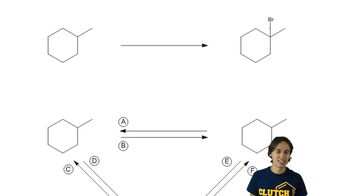
Functionalizing Alkanes