
Ch.5 - Stereochemistry
Wade - Organic Chemistry 9th Edition
Wade9th EditionOrganic ChemistryISBN: 9780135213728Not the one you use?Change textbook
Chapter 5, Problem 25

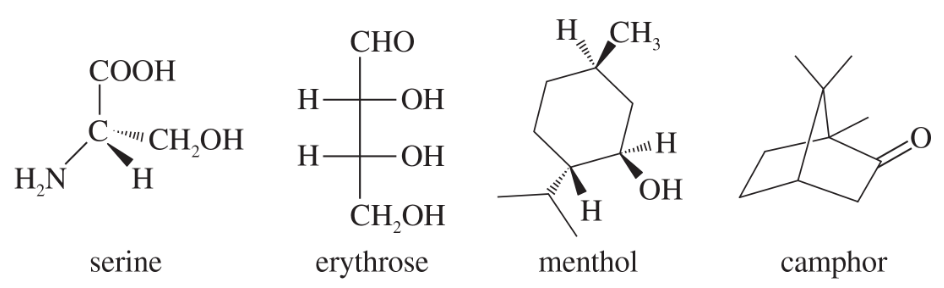
The following four structures are naturally occurring optically active compounds. Star (*) the asymmetric carbon atoms in these structures.

Verified step by step guidance
1
Identify the asymmetric carbon atoms in each structure. An asymmetric carbon is a carbon atom that is attached to four different groups or atoms.
For serine: Examine the central carbon atom (C) bonded to -NH2, -COOH, -H, and -CH2OH. This carbon is asymmetric because it is bonded to four different groups.
For erythrose: Look at the two middle carbon atoms in the chain. Each of these carbons is bonded to -H, -OH, and two different groups (CHO and CH2OH for one, and CHO and CHOH for the other). Both are asymmetric.
For menthol: Examine the cyclohexane ring. The carbon bonded to -CH3, -H, -OH, and the ring is asymmetric. Additionally, the carbon bonded to -H, -CH3, and two different parts of the ring is also asymmetric.
For camphor: Analyze the bicyclic structure. The carbon atom bonded to the ketone group (C=O), -H, and two different parts of the bicyclic structure is asymmetric. Another asymmetric carbon is present in the ring system where it is bonded to -H, -CH3, and two different parts of the ring.

Verified video answer for a similar problem:

This video solution was recommended by our tutors as helpful for the problem above.
Video duration:
2m
Was this helpful?

Key Concepts

Here are the essential concepts you must grasp in order to answer the question correctly.

Asymmetric Carbon Atom

An asymmetric carbon atom, also known as a chiral center, is a carbon atom that is bonded to four different groups or atoms. This unique arrangement allows for the existence of two non-superimposable mirror images, known as enantiomers. Identifying these carbon atoms is crucial in understanding the optical activity of compounds, as they contribute to the molecule's chirality.
Recommended video:
Guided course
01:44
The difference between atomic numbers and atomic mass.

Optical Activity

Optical activity refers to the ability of a chiral compound to rotate the plane of polarized light. This property arises from the presence of asymmetric carbon atoms in the molecule. The direction and degree of rotation depend on the specific enantiomer, making optical activity a key characteristic in distinguishing between different chiral compounds.
Recommended video:
Guided course
08:17
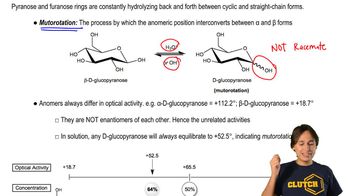
Mutorotation and Optical Activity

Chirality in Organic Compounds

Chirality is a geometric property of some molecules that makes them non-superimposable on their mirror images. In organic chemistry, chirality is often associated with the presence of asymmetric carbon atoms. Understanding chirality is essential for predicting the behavior of molecules in biological systems, as different enantiomers can have vastly different effects in chemical reactions and biological interactions.
Recommended video:
Guided course
01:40
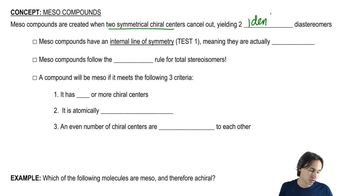
Defining meso compounds.