Ch. 18 - Reactions of Benzene and Substituted Benzenes
Bruice - Organic Chemistry 8th Edition
Bruice8th EditionOrganic ChemistryISBN: 9780135213711Not the one you use?Change textbook
Chapter 19, Problem 43d

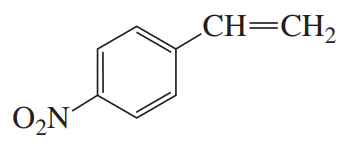
Name the following:
d. Chemical structure of a benzene ring with a nitro group (O2N) and an ethylene group (CH=CH2) attached.

Verified step by step guidance
1
Step 1: Identify the parent structure. The parent structure is a benzene ring, which is an aromatic compound.
Step 2: Determine the substituents attached to the benzene ring. There are two substituents: a nitro group (-NO₂) and an ethyl group (-CH₂CH₃).
Step 3: Assign positions to the substituents on the benzene ring. The nitro group is at position 1 (default starting point for naming), and the ethyl group is at position 2 relative to the nitro group.
Step 4: Name the substituents and combine them with the parent structure. The nitro group is named 'nitro,' and the ethyl group is named 'ethyl.' The positions are indicated numerically.
Step 5: Combine the names of the substituents with the parent structure in alphabetical order, ensuring the positions are included. The final name will follow IUPAC nomenclature rules.

Verified video answer for a similar problem:

This video solution was recommended by our tutors as helpful for the problem above.
Video duration:
4m
Was this helpful?

Key Concepts

Here are the essential concepts you must grasp in order to answer the question correctly.

Benzene Ring Structure

The benzene ring is a fundamental structure in organic chemistry, characterized by its six carbon atoms arranged in a planar hexagonal ring with alternating double bonds. This resonance structure allows for delocalization of electrons, contributing to the stability and unique reactivity of aromatic compounds. Understanding the properties of benzene is crucial for naming and identifying derivatives.
Recommended video:
Guided course
09:04
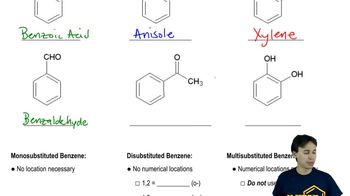
Benzene Nomenclature

Substituent Nomenclature

In organic chemistry, substituents are atoms or groups that replace hydrogen atoms in a hydrocarbon. The naming of compounds involves identifying the main chain and the substituents attached to it. For example, in nitrobenzene, the nitro group (NO2) is a substituent on the benzene ring, and its position relative to other groups is essential for proper nomenclature.
Recommended video:
2:14
Nomenclature of Heterocycles Concept 3

IUPAC Naming Conventions

The International Union of Pure and Applied Chemistry (IUPAC) provides systematic rules for naming chemical compounds. For aromatic compounds like nitrobenzene, the IUPAC name is derived from the parent hydrocarbon (benzene) with the substituent (nitro) indicated. The position of the substituent is specified using numbers based on the carbon atoms in the ring, ensuring clarity and consistency in chemical communication.
Recommended video:
Guided course
03:43
The different parts of an IUPAC name