Ch. 21 - Carboxylic Acid Derivatives
Wade - Organic Chemistry 9th Edition
Wade9th EditionOrganic ChemistryISBN: 9780135213728Not the one you use?Change textbook
Chapter 21, Problem 39a

Show how each transformation may be accomplished by using a nitrile as an intermediate. You may use any necessary reagents.
(a) hexan-1-ol → heptan-1-amine

Verified step by step guidance
1
Step 1: Convert hexan-1-ol to hexanenitrile. This can be achieved by first converting hexan-1-ol to hexyl bromide (or another alkyl halide) using PBr₃ or HBr. Then, perform a nucleophilic substitution reaction with NaCN or KCN to introduce the nitrile group, forming hexanenitrile.
Step 2: Extend the carbon chain of hexanenitrile by one carbon atom. This can be done using a Grignard reagent (e.g., CH₃MgBr) to react with the nitrile group, forming an imine intermediate.
Step 3: Hydrolyze the imine intermediate to form a ketone. This can be achieved by treating the imine with water under acidic conditions.
Step 4: Reduce the ketone to a primary amine. Use a reducing agent such as LiAlH₄ or catalytic hydrogenation (H₂/Pd) to convert the ketone to heptan-1-amine.
Step 5: Verify the structure of the final product, heptan-1-amine, ensuring that the carbon chain has been extended by one carbon and the functional group has been converted to an amine.

Verified video answer for a similar problem:

This video solution was recommended by our tutors as helpful for the problem above.
Video duration:
2m
Was this helpful?

Key Concepts

Here are the essential concepts you must grasp in order to answer the question correctly.

Nitrile Chemistry

Nitriles are organic compounds containing a cyano group (-C≡N) and can serve as versatile intermediates in organic synthesis. They can be converted into various functional groups, including amines, through hydrolysis or reduction. Understanding the reactivity of nitriles is crucial for designing synthetic pathways, as they can facilitate the transformation of alcohols to amines.
Recommended video:
Guided course
01:01
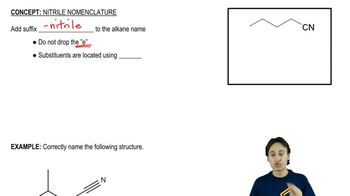
Nitrile Nomenclature

Reduction Reactions

Reduction reactions involve the gain of electrons or the decrease in oxidation state of a molecule. In the context of nitriles, they can be reduced to primary amines using reagents such as lithium aluminum hydride (LiAlH4) or hydrogen gas in the presence of a catalyst. Recognizing the appropriate reducing agents is essential for successfully converting nitriles into amines.
Recommended video:
Guided course
07:12
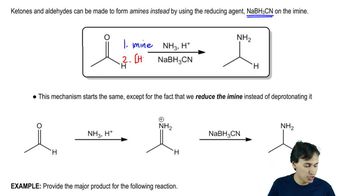
Reductive Amination

Synthetic Pathways

Synthetic pathways are sequences of chemical reactions that transform reactants into desired products. In this case, the pathway from hexan-1-ol to heptan-1-amine involves the formation of a nitrile intermediate. Understanding how to construct these pathways, including the selection of reagents and reaction conditions, is vital for achieving the desired transformation efficiently.
Recommended video:
2:13
Energy Production In Biochemical Pathways Concept 1