Ch. 3 - Alkanes and Cycloalkanes: Properties and Conformational Analysis
Mullins - Organic Chemistry: A Learner Centered Approach 1st Edition
Mullins1st EditionOrganic Chemistry: A Learner Centered ApproachISBN: 9780137566471Not the one you use?Change textbook
Chapter 2, Problem 2

What is the ground state electron configuration of carbon? How many bonds does carbon usually form?

Verified step by step guidance
1
Step 1: Understand the concept of electron configuration. The ground state electron configuration describes the arrangement of electrons in an atom's orbitals when it is in its lowest energy state.
Step 2: Determine the atomic number of carbon. Carbon has an atomic number of 6, which means it has 6 electrons in its neutral state.
Step 3: Fill the orbitals according to the Aufbau principle, which states that electrons occupy the lowest energy orbitals first. The order of filling is: 1s, 2s, 2p, 3s, etc.
Step 4: Write the electron configuration for carbon. Using the Aufbau principle, the first two electrons fill the 1s orbital, the next two fill the 2s orbital, and the remaining two electrons partially fill the 2p orbital. The configuration is: 1s22s22p2.
Step 5: Explain bonding. Carbon typically forms 4 bonds because it has 4 valence electrons (2 in the 2s orbital and 2 in the 2p orbital) and needs 4 more electrons to complete its octet. This is why carbon is tetravalent and forms covalent bonds in most compounds.

Verified video answer for a similar problem:

This video solution was recommended by our tutors as helpful for the problem above.
Video duration:
4m
Was this helpful?

Key Concepts

Here are the essential concepts you must grasp in order to answer the question correctly.

Electron Configuration

Electron configuration describes the distribution of electrons in an atom's orbitals. For carbon, which has six electrons, the ground state electron configuration is 1s² 2s² 2p². This notation indicates that two electrons occupy the first energy level (1s), while four electrons are distributed in the second energy level (2s and 2p). Understanding electron configuration is crucial for predicting an element's chemical behavior.
Recommended video:
Guided course
02:14
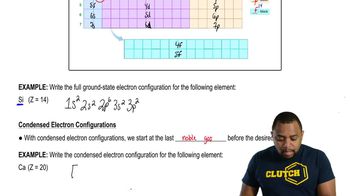
The Electron Configuration

Valence Electrons

Valence electrons are the outermost electrons of an atom and are key to determining how an element interacts with others. In carbon, the four valence electrons (two in 2s and two in 2p) allow it to form various types of bonds. The number of valence electrons directly influences the bonding capacity and the types of molecules carbon can create, making it a versatile element in organic chemistry.
Recommended video:
Guided course
03:40
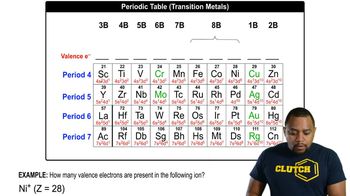
Valence Electrons of Transition Metals

Covalent Bonding

Covalent bonding occurs when two atoms share electrons to achieve a full outer shell, leading to greater stability. Carbon typically forms four covalent bonds due to its four valence electrons, allowing it to bond with other carbon atoms or different elements. This ability to form multiple bonds is fundamental to the structure and diversity of organic compounds, including hydrocarbons and biomolecules.
Recommended video:
Guided course
11:33
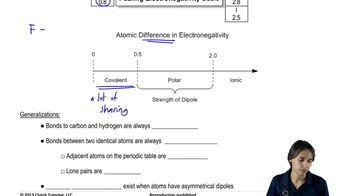
Differences between ionic, polar and covalent bonds