Ch. 7 - Structure and Synthesis of Alkenes; Elimination
Wade - Organic Chemistry 9th Edition
Wade9th EditionOrganic ChemistryISBN: 9780135213728Not the one you use?Change textbook
Chapter 7, Problem 56d,e,f

Using cyclohexane as your starting material, show how you would synthesize each of the following compounds. (Once you have shown how to synthesize a compound, you may use it as the starting material in any later parts of this problem.)
d. 3-bromocyclohex-1-ene
e. cyclohexa-1,3-diene
f. cyclohexanol

Verified step by step guidance
1
Step 1: To synthesize 3-bromocyclohex-1-ene (part d), start with cyclohexane. First, perform a halogenation reaction using bromine (Br₂) in the presence of UV light to introduce a bromine atom onto the cyclohexane ring, forming bromocyclohexane.
Step 2: Next, perform an elimination reaction on bromocyclohexane to form cyclohexene. Use a strong base, such as potassium tert-butoxide (KOtBu), to remove a hydrogen atom and the bromine atom, resulting in the formation of a double bond.
Step 3: To introduce the bromine at the 3-position of cyclohexene, perform an allylic bromination reaction. Use N-bromosuccinimide (NBS) in the presence of light or a radical initiator to selectively brominate the allylic position, yielding 3-bromocyclohex-1-ene.
Step 4: For part e, to synthesize cyclohexa-1,3-diene, start with cyclohexene (from Step 2). Perform a dehydrohalogenation reaction using a strong base, such as sodium amide (NaNH₂), to remove a hydrogen atom and a halogen atom, forming a second double bond and yielding cyclohexa-1,3-diene.
Step 5: For part f, to synthesize cyclohexanol, start with cyclohexane. Perform a hydroxylation reaction by oxidizing cyclohexane using a reagent such as potassium permanganate (KMnO₄) or osmium tetroxide (OsO₄) to introduce a hydroxyl group, forming cyclohexanol.

Verified video answer for a similar problem:

This video solution was recommended by our tutors as helpful for the problem above.
Video duration:
7m
Was this helpful?

Key Concepts

Here are the essential concepts you must grasp in order to answer the question correctly.

Electrophilic Addition Reactions

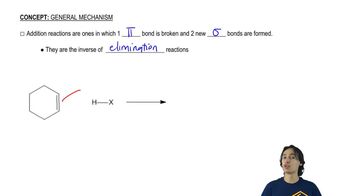
Electrophilic addition reactions involve the addition of an electrophile to a nucleophile, typically across a double bond. In the context of synthesizing compounds from cyclohexane, understanding how to add bromine or other electrophiles to alkenes is crucial. This concept is essential for forming products like 3-bromocyclohex-1-ene and cyclohexa-1,3-diene, where the reactivity of the double bond is exploited.
Recommended video:
Guided course
05:39
Features of Addition Mechanisms.

Rearrangement Reactions

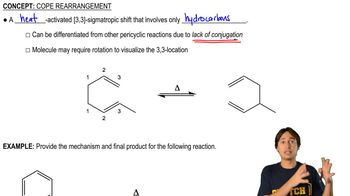
Rearrangement reactions involve the reorganization of atoms within a molecule to form a new structure. This concept is particularly relevant when synthesizing compounds like cyclohexa-1,3-diene from cyclohexane, as it may require the formation of intermediates that rearrange to achieve the desired product. Understanding the mechanisms of these reactions helps predict the outcomes of synthetic pathways.
Recommended video:
Guided course
06:28
Definition of Cope Rearrangement

Functional Group Interconversion

Functional group interconversion refers to the transformation of one functional group into another, which is vital in organic synthesis. For example, converting cyclohexane to cyclohexanol involves the introduction of a hydroxyl group, while synthesizing 3-bromocyclohex-1-ene requires the formation of a double bond. Mastery of this concept allows chemists to navigate the synthesis of diverse organic compounds effectively.
Recommended video:
Guided course
02:36
Identifying Functional Groups