Ch. 13 - Alcohols, Ethers and Related Compounds: Substitution and Elimination
Mullins - Organic Chemistry: A Learner Centered Approach 1st Edition
Mullins1st EditionOrganic Chemistry: A Learner Centered ApproachISBN: 9780137566471Not the one you use?Change textbook
Chapter 12, Problem 88d

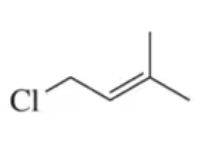
Predict the product(s) that would result when the following molecules are allowed to react under the following conditions: (i) 1. BH3 2. NaOH, H2O2 (ii) 1. Hg(OAc)2 2. NaBH4 (iii) H2SO4 , H2O (iv) 1. OsO4 2. NaHSO3 (v) H2O (vi) NaOH, H2O . If there is no reaction, write 'no reaction.'
(d)

Verified step by step guidance
1
Step 1: Analyze the given reaction conditions for each case. Each set of reagents corresponds to a specific organic reaction mechanism. For example, (i) involves hydroboration-oxidation, (ii) involves oxymercuration-demercuration, (iii) involves acid-catalyzed hydration, (iv) involves syn-dihydroxylation, (v) involves simple hydration, and (vi) involves basic hydrolysis.
Step 2: For (i) 1. BH₃ 2. NaOH, H₂O₂: This is a hydroboration-oxidation reaction. It adds water (H and OH) across a double bond in an anti-Markovnikov fashion, with syn addition. Identify the double bond in the molecule and predict the product by adding H to the more substituted carbon and OH to the less substituted carbon.
Step 3: For (ii) 1. Hg(OAc)₂ 2. NaBH₄: This is an oxymercuration-demercuration reaction. It adds water (H and OH) across a double bond in a Markovnikov fashion, without carbocation rearrangement. Locate the double bond in the molecule and predict the product by adding OH to the more substituted carbon and H to the less substituted carbon.
Step 4: For (iii) H₂SO₄, H₂O: This is an acid-catalyzed hydration reaction. It adds water (H and OH) across a double bond in a Markovnikov fashion, but carbocation rearrangement is possible. Identify the double bond, consider possible rearrangements, and predict the product by adding OH to the more substituted carbon and H to the less substituted carbon.
Step 5: For (iv) 1. OsO₄ 2. NaHSO₃: This is a syn-dihydroxylation reaction. It adds two hydroxyl groups (OH and OH) across a double bond in a syn fashion. Locate the double bond in the molecule and predict the product by adding OH groups to both carbons of the double bond on the same side of the molecule.

Verified video answer for a similar problem:

This video solution was recommended by our tutors as helpful for the problem above.
Video duration:
2m
Was this helpful?

Key Concepts

Here are the essential concepts you must grasp in order to answer the question correctly.

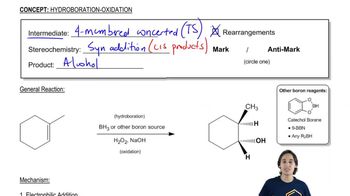
Hydroboration-Oxidation

Hydroboration-oxidation is a two-step reaction that converts alkenes into alcohols. In the first step, BH₃ adds to the double bond of the alkene, forming a trialkylborane intermediate. The second step involves oxidation with H₂O₂ and NaOH, which replaces the boron with a hydroxyl group, yielding an alcohol. This reaction is notable for its anti-Markovnikov selectivity.
Recommended video:
Guided course
06:38
General properties of hydroboration-oxidation.

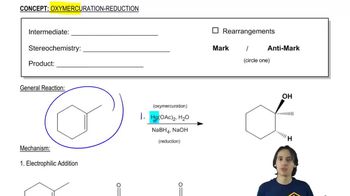
Oxymercuration-Demercuration

Oxymercuration-demercuration is a method for converting alkenes to alcohols via mercuric acetate. The alkene reacts with Hg(OAc)₂ to form a mercurial intermediate, which is then reduced by NaBH₄ to yield an alcohol. This reaction follows Markovnikov's rule, where the hydroxyl group attaches to the more substituted carbon of the alkene.
Recommended video:
Guided course
05:
General properties of oxymercuration-reduction.

Sulfation and Hydration Reactions

Sulfation and hydration reactions involve the addition of sulfuric acid (H₂SO₄) and water (H₂O) to alkenes. The alkene reacts with H₂SO₄ to form an alkyl sulfate, which can then be hydrolyzed to produce an alcohol. This reaction also adheres to Markovnikov's rule, leading to the formation of more stable carbocation intermediates.
Recommended video:
Guided course
09:11
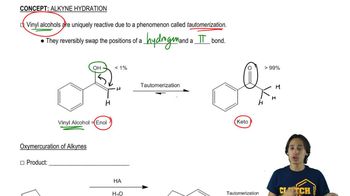
Alkyne Hydration