

Ch.8 - Reactions of Alkenes
Wade - Organic Chemistry 9th Edition
Wade9th EditionOrganic ChemistryISBN: 9780135213728Not the one you use?Change textbook
Chapter 8, Problem 51b

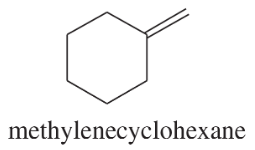
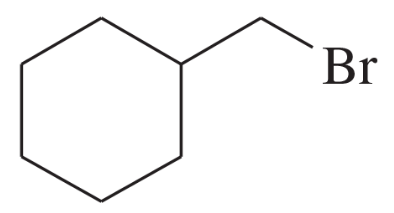
Show how you would synthesize each compound using methylenecyclopentane as your starting material.

(b)

Verified step by step guidance
1
Step 1: Begin with methylenecyclopentane as the starting material. Methylenecyclopentane is an alkene, which can undergo electrophilic addition reactions to introduce functional groups.
Step 2: Perform a hydrohalogenation reaction using HCl. The double bond in methylenecyclopentane will react with HCl, following Markovnikov's rule, to add a chlorine atom to the more substituted carbon and a hydrogen atom to the less substituted carbon.
Step 3: The product from Step 2 will be 1-chlorocyclopentane. To introduce the methyl group, perform a free radical halogenation reaction using Cl2 and UV light to replace one of the hydrogens on the cyclopentane ring with a chlorine atom.
Step 4: React the chlorinated cyclopentane with methylmagnesium bromide (a Grignard reagent) to replace the chlorine atom with a methyl group, forming 2-methylcyclopentane.
Step 5: Finally, perform a ring-opening reaction using HCl in the presence of heat to convert 2-methylcyclopentane into 1-chloro-2-methylbutane. This step involves breaking the cyclopentane ring and forming the desired linear compound.

Verified video answer for a similar problem:

This video solution was recommended by our tutors as helpful for the problem above.
Video duration:
3m
Was this helpful?

Key Concepts

Here are the essential concepts you must grasp in order to answer the question correctly.

Synthesis of Organic Compounds

Organic synthesis involves the construction of complex chemical compounds from simpler ones. Understanding the principles of synthesis is crucial for designing pathways to create specific molecules, such as using methylenecyclopentane as a starting material. This includes knowledge of reaction mechanisms, functional group transformations, and the ability to predict the products of chemical reactions.
Recommended video:
Guided course
01:40
Defining meso compounds.

Reaction Mechanisms

A reaction mechanism describes the step-by-step process by which reactants are converted into products. It includes details about bond breaking and forming, intermediates, and transition states. Familiarity with common mechanisms, such as nucleophilic substitutions or electrophilic additions, is essential for predicting how methylenecyclopentane can be transformed into the desired compounds.
Recommended video:
Guided course
02:16
Heck Reaction Mechanism

Functional Groups

Functional groups are specific groups of atoms within molecules that are responsible for the characteristic chemical reactions of those molecules. Identifying and understanding functional groups is vital for predicting reactivity and guiding synthesis. In the context of methylenecyclopentane, recognizing how different functional groups can be introduced or modified will aid in synthesizing the target compounds effectively.
Recommended video:
Guided course
02:36
Identifying Functional Groups