Ch. 11 - Organometallic Compounds
Bruice - Organic Chemistry 8th Edition
Bruice8th EditionOrganic ChemistryISBN: 9780135213711Not the one you use?Change textbook
Chapter 12, Problem 10d

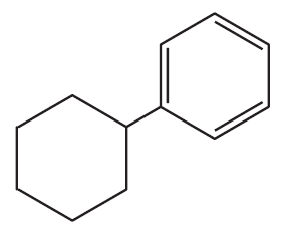
How could the following compounds be prepared, using cyclohexene as a starting material?
d. Chemical structures of cyclohexene and a carbonyl compound, illustrating a reaction pathway.

Verified step by step guidance
1
Identify the target compound and analyze its functional groups and structure. Determine the transformations required to convert cyclohexene into the target compound.
Examine the structure of cyclohexene, which is a six-membered ring with one double bond. Consider reactions that can modify the double bond or add functional groups to the ring.
Propose a sequence of reactions based on the functional groups in the target compound. For example, if the target compound contains an alcohol group, consider hydroboration-oxidation or acid-catalyzed hydration of cyclohexene.
If the target compound contains a halogen, consider reactions such as electrophilic addition of halogens (e.g., Br₂ or Cl₂) or hydrohalogenation (e.g., HBr or HCl) to the double bond of cyclohexene.
For more complex functional groups, consider multi-step synthesis. For example, if the target compound contains a ketone, consider oxidizing an alcohol intermediate or performing ozonolysis of cyclohexene to cleave the double bond and form a ketone.

Verified video answer for a similar problem:

This video solution was recommended by our tutors as helpful for the problem above.
Was this helpful?

Key Concepts

Here are the essential concepts you must grasp in order to answer the question correctly.

Electrophilic Addition Reactions

Electrophilic addition reactions are fundamental in organic chemistry, particularly for alkenes like cyclohexene. In these reactions, an electrophile reacts with the double bond of the alkene, leading to the formation of a more stable carbocation intermediate. This process allows for the introduction of various functional groups, which can be crucial for synthesizing different compounds from cyclohexene.
Recommended video:
Guided course
05:39
Features of Addition Mechanisms.

Rearrangement Reactions

Rearrangement reactions involve the structural reorganization of a molecule, often resulting in the formation of more stable isomers. In the context of cyclohexene, these reactions can occur after electrophilic addition, where the initial carbocation may shift to a more stable position. Understanding these rearrangements is essential for predicting the products formed during the synthesis of compounds from cyclohexene.
Recommended video:
Guided course
06:08
Definition of Claisen Rearrangement

Functional Group Transformations

Functional group transformations refer to the chemical reactions that convert one functional group into another, which is vital for organic synthesis. Starting from cyclohexene, various transformations can be employed, such as hydrogenation, halogenation, or oxidation, to create desired products. Mastery of these transformations allows chemists to design synthetic pathways effectively and achieve specific molecular architectures.
Recommended video:
Guided course
02:36
Identifying Functional Groups