Ch. 15 - Reactions of Carboxylic Acids and Carboxylic Acid Derivatives
Bruice - Organic Chemistry 8th Edition
Bruice8th EditionOrganic ChemistryISBN: 9780135213711Not the one you use?Change textbook
Chapter 16, Problem 80

When a compound with molecular formula C11H14O2 undergoes acid-catalyzed hydrolysis, one of the products that is isolated gives the following 1H NMR spectrum. Identify the compound.

Verified step by step guidance
1
Analyze the molecular formula C11H14O2 to determine the degree of unsaturation using the formula: Degree of Unsaturation = (2C + 2 - H + N - X)/2, where C = number of carbons, H = number of hydrogens, N = number of nitrogens, and X = number of halogens.
Recognize that acid-catalyzed hydrolysis typically involves the cleavage of ester or amide bonds, producing carboxylic acids and alcohols or amines as products. This suggests the compound may contain an ester functional group.
Examine the 1H NMR spectrum of the product. Look for characteristic signals such as: (1) a singlet around 10-12 ppm indicating a carboxylic acid proton, (2) signals in the 3-4 ppm range for protons on carbons adjacent to oxygen, and (3) aromatic signals in the 6-8 ppm range if an aromatic ring is present.
Propose a structure for the original compound based on the molecular formula, degree of unsaturation, and the functional groups suggested by the NMR data. Consider how hydrolysis would break the compound into the observed product.
Verify the proposed structure by ensuring it matches the molecular formula C11H14O2, accounts for the degree of unsaturation, and explains the observed NMR spectrum of the hydrolysis product.

Verified video answer for a similar problem:

This video solution was recommended by our tutors as helpful for the problem above.
Was this helpful?

Key Concepts

Here are the essential concepts you must grasp in order to answer the question correctly.

Molecular Formula Interpretation

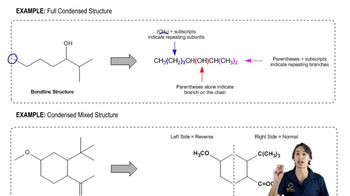
The molecular formula C11H14O2 indicates the compound contains 11 carbon atoms, 14 hydrogen atoms, and 2 oxygen atoms. Understanding how to interpret this formula is crucial for deducing the possible structure of the compound and its functional groups, which can influence its reactivity and the products formed during reactions such as hydrolysis.
Recommended video:
Guided course
06:06
How to interpret condensed structures.

Acid-Catalyzed Hydrolysis

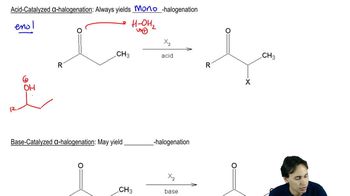
Acid-catalyzed hydrolysis is a reaction where a compound reacts with water in the presence of an acid, leading to the cleavage of bonds and the formation of new products. This process is essential for understanding how the original compound transforms and what functional groups may be generated, which can be identified through techniques like NMR spectroscopy.
Recommended video:
Guided course
03:09
Acid Catalyzed

NMR Spectroscopy

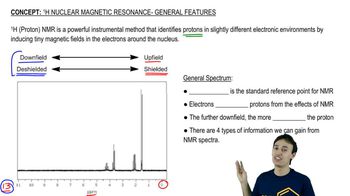
Nuclear Magnetic Resonance (NMR) spectroscopy is a powerful analytical technique used to determine the structure of organic compounds. The 1H NMR spectrum provides information about the hydrogen environments in a molecule, allowing chemists to deduce the arrangement of atoms and identify functional groups, which is critical for identifying the product of the hydrolysis reaction.
Recommended video:
Guided course
10:06
General NMR Features