Ch. 2 - Acids and Bases; Functional Groups
Wade - Organic Chemistry 9th Edition
Wade9th EditionOrganic ChemistryISBN: 9780135213728Not the one you use?Change textbook
Chapter 2, Problem 35c,d

Predict which compound in each pair has the higher boiling point. Explain your prediction.
(c) CH3CH2CH2CH2CH3 or (CH3)2CH2CH2CH3
(d) CH3CH2CH2CH2CH3 or CH3CH2CH2CH2CH2Cl

Verified step by step guidance
1
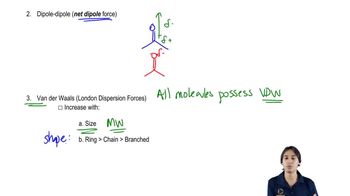
Step 1: Understand that boiling point is influenced by molecular weight, intermolecular forces, and molecular structure. Larger molecules and those with stronger intermolecular forces generally have higher boiling points.
Step 2: For part c, compare the two compounds: CH3CH2CH2CH2CH3 (pentane) and (CH3)2CH2CH2CH3 (isopentane). Both have the same molecular formula, C5H12, but differ in structure. Pentane is a straight-chain alkane, while isopentane is branched.
Step 3: Recognize that straight-chain alkanes typically have higher boiling points than their branched counterparts due to more effective van der Waals interactions. Therefore, predict that CH3CH2CH2CH2CH3 (pentane) has a higher boiling point than (CH3)2CH2CH2CH3 (isopentane).
Step 4: For part d, compare CH3CH2CH2CH2CH3 (pentane) and CH3CH2CH2CH2CH2Cl (1-chloropentane). Note that 1-chloropentane has a chlorine atom, which introduces dipole-dipole interactions, a stronger intermolecular force than the van der Waals forces present in pentane.
Step 5: Predict that CH3CH2CH2CH2CH2Cl (1-chloropentane) has a higher boiling point than CH3CH2CH2CH2CH3 (pentane) due to the presence of dipole-dipole interactions from the chlorine atom.

Verified video answer for a similar problem:

This video solution was recommended by our tutors as helpful for the problem above.
Video duration:
4m
Was this helpful?

Key Concepts

Here are the essential concepts you must grasp in order to answer the question correctly.

Intermolecular Forces

Intermolecular forces are the forces that hold molecules together, influencing properties like boiling points. The main types are London dispersion forces, dipole-dipole interactions, and hydrogen bonding. Stronger intermolecular forces result in higher boiling points because more energy is required to separate the molecules.
Recommended video:
Guided course
03:01
How Van der Waals forces work.

Molecular Structure and Branching

The structure of a molecule, including its branching, affects its boiling point. Linear molecules can pack closely together, enhancing intermolecular forces, while branched molecules have less surface area contact, reducing these forces. Thus, linear molecules typically have higher boiling points than their branched counterparts.
Recommended video:
Guided course
08:41
Review of Molecular Orbitals

Functional Groups and Polarity

Functional groups and molecular polarity significantly impact boiling points. Polar molecules, or those with polar functional groups, exhibit stronger dipole-dipole interactions compared to nonpolar molecules. For example, the presence of a chlorine atom increases polarity, leading to higher boiling points due to stronger intermolecular attractions.
Recommended video:
Guided course
02:36
Identifying Functional Groups
Related Practice
Textbook Question

Rank the following species in order of increasing acidity. Explain your reasons for ordering them as you do.

HF NH3 H2SO4 CH3OH CH3COOH H3O+ H2O

2411
views

Textbook Question

All of the following compounds can react as acids. Without using a table of acidities, rank them in order of increasing acidity. Explain your ranking.

a. CH3CH2SO3H

b. CH3CH2OH

c. CH3CH2COOH

d. CH3CHClCOOH

e. ClCH2CH2COOH

1659
views
2
rank
Textbook Question

N-Methylpyrrolidine has a boiling point of 81 °C, and piperidine has a boiling point of 106 °C.

c. N,N-Dimethylformamide has a boiling point of 150 °C, and N-methylacetamide has a boiling point of 206 °C, for a difference of 56 °C. Explain why these two nitrogen-containing isomers have a much larger boiling point difference than the two amine isomers. Also explain why these two amides have higher boiling points than any of the other four compounds shown (two amines, an ether, and an alcohol).

952
views
Textbook Question

Predict which compound in each pair has the higher boiling point. Explain your prediction.

(a) CH3CH2OCH3 or CH3CH(OH)CH3

(b) CH3CH2CH2CH3 or CH3CH2CH2CH2CH3

3426
views
Textbook Question

Predict which compound in each pair has the higher boiling point. Explain your prediction.

(e)

(f)

1664
views
Textbook Question

N-Methylpyrrolidine has a boiling point of 81 °C, and piperidine has a boiling point of 106 °C.

b. Tetrahydropyran has a boiling point of 88 °C, and cyclopentanol has a boiling point of 141 °C. These two isomers have a boiling point difference of 53 °C. Explain why the two oxygen-containing isomers have a much larger boiling point difference than the two amine isomers.

1331
views